Blainville’s beaked whale
Mesoplodon densirostris
biology
Blainville’s beaked whales reach lengths of 4.5 m to 6 m and weigh about 1 tonne. Newborns are typically between 1.9 m and 2.6 m long. This species possesses one of the most remarkable records in nature: their jaw bones have the highest density of any bone in the animal kingdom, which is reflected in their scientific name densirostris ("dense beak").
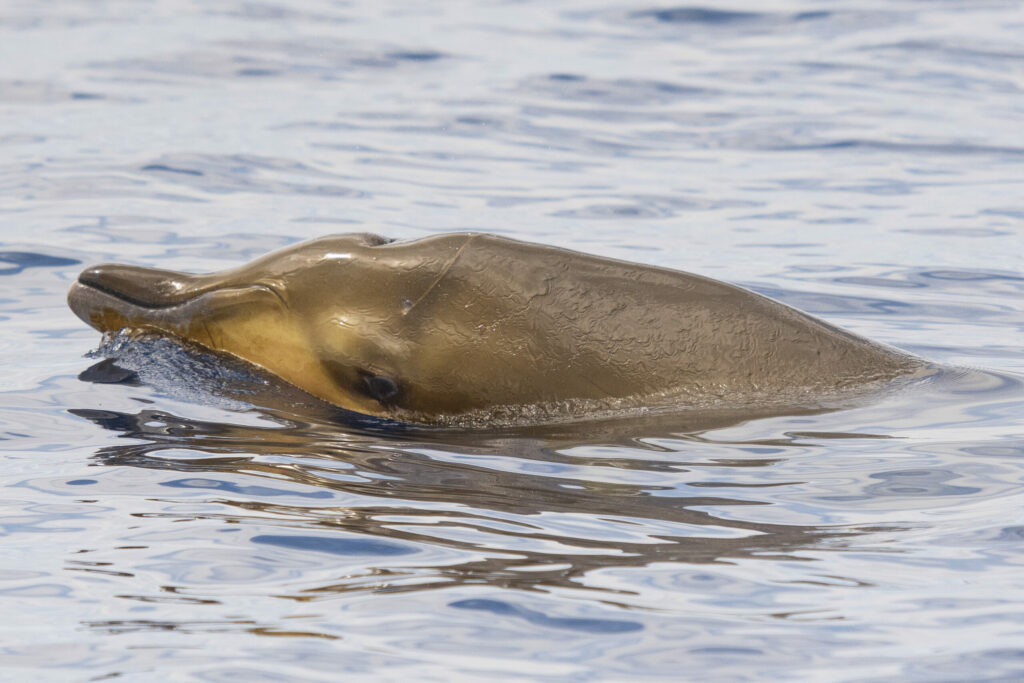
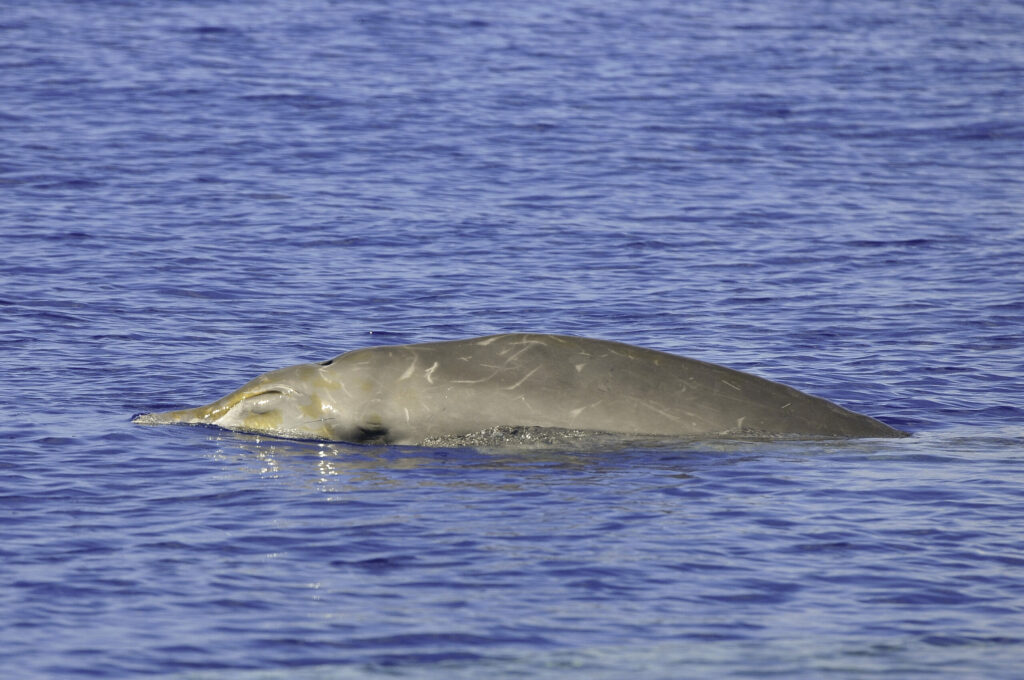
The body is robust, with a flattened forehead and a moderately long beak. The mouthline is unmistakable, featuring an abrupt, high-arched "step" midway along the jaw. In adult males, two massive, horn-like teeth erupt from these arches; these tusks often become encrusted with barnacles, giving the appearance of dark "pom-poms" on top of the head. Their coloration is a subtle counter-shading of brownish or bluish-grey on the back and light grey on the belly. Adult bodies are typically covered in scars from social interactions and oval-shaped white marks from cookie-cutter shark bites.
Like other beaked whales, they forage at great depths primarily for squid but also for deep-water fish. Blainville’s are usually found in small groups of 3 to 7 individuals, often consisting of one adult male with several females and their calves, while subadults may form separate bachelor groups.
The body is robust, with a flattened forehead and a moderately long beak. The mouthline is unmistakable, featuring an abrupt, high-arched "step" midway along the jaw. In adult males, two massive, horn-like teeth erupt from these arches; these tusks often become encrusted with barnacles, giving the appearance of dark "pom-poms" on top of the head. Their coloration is a subtle counter-shading of brownish or bluish-grey on the back and light grey on the belly. Adult bodies are typically covered in scars from social interactions and oval-shaped white marks from cookie-cutter shark bites.
Like other beaked whales, they forage at great depths primarily for squid but also for deep-water fish. Blainville’s are usually found in small groups of 3 to 7 individuals, often consisting of one adult male with several females and their calves, while subadults may form separate bachelor groups.
observation
Blainville’s beaked whales are widely distributed in tropical and warm temperate waters. They are among the most studied beaked whales due to well-known resident populations in island chains like the Bahamas. In higher latitudes, their presence is often associated with warm ocean currents such as the Gulf Stream.
Identification Tips: Adult males are easy to recognize due to their unique "step" jaw and eruptive tusks. When surfacing, they often bring their beak out of the water first, pointed toward the sky, before leveling out to breathe. At a distance or when viewing females, they can be easily confused with other Mesoplodon species of similar size.
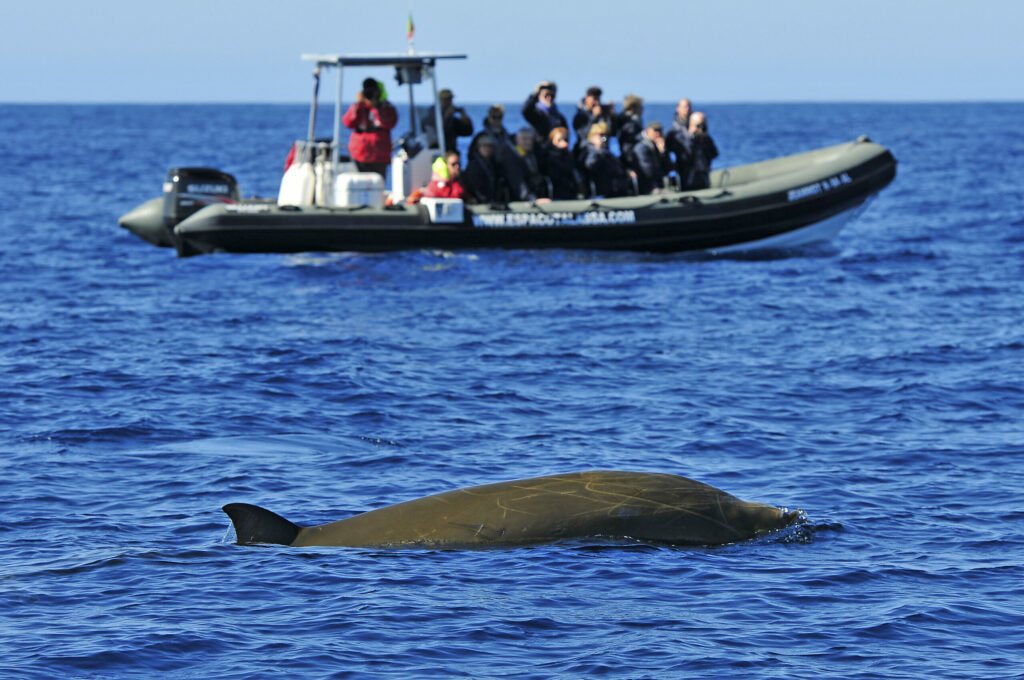
The Espaço Talassa team first recorded this species in 2007. Since then, we have observed them annually in low numbers (1 to 6 sightings per season). While they can be seen from April to October, encounters are most frequent during the peak summer months of June to August.
Identification Tips: Adult males are easy to recognize due to their unique "step" jaw and eruptive tusks. When surfacing, they often bring their beak out of the water first, pointed toward the sky, before leveling out to breathe. At a distance or when viewing females, they can be easily confused with other Mesoplodon species of similar size.
The Espaço Talassa team first recorded this species in 2007. Since then, we have observed them annually in low numbers (1 to 6 sightings per season). While they can be seen from April to October, encounters are most frequent during the peak summer months of June to August.
names
PT: Zífio-de-blainville (ou Baleia-de-bico-de-blainville)
ENG: Blainville’s beaked whale (or Dense beaked whale)
FR: Baleine à bec de Blainville
DE: Blainville-Schnabelwal
IT: Mesoplodonte di De Blainville
ESP: Zifio de Blainville
NL: Spitssnuitdolfijn van de Blainville
ENG: Blainville’s beaked whale (or Dense beaked whale)
FR: Baleine à bec de Blainville
DE: Blainville-Schnabelwal
IT: Mesoplodonte di De Blainville
ESP: Zifio de Blainville
NL: Spitssnuitdolfijn van de Blainville
Scientific name
Mesoplodon densirostris
Discovery
Blainville, 1817