


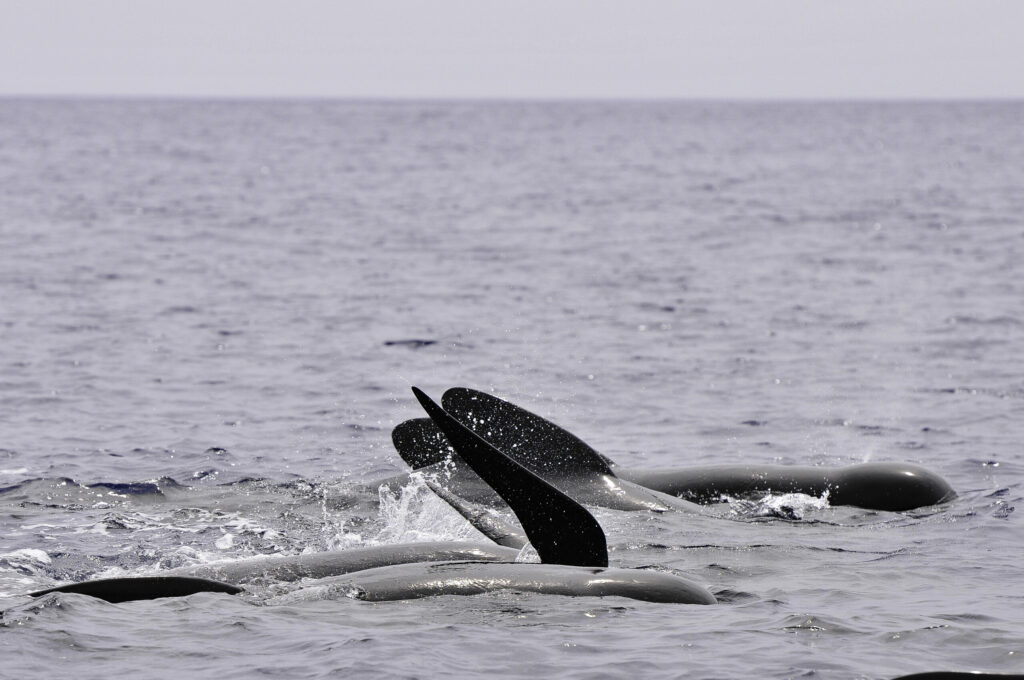
Long-finned pilot whale
Globicephala melas
biology
Newborn long-finned pilot whales are approximately 1.8 m to 2 m long. Adult males can grow up to 6 m in length (some records reach 6.7 m), while females are smaller, typically reaching about 5.5 m. Males can weigh up to 3.5 tonnes, significantly more than females. One way to distinguish them from their tropical relatives is their dentition, having more teeth (16 to 24 per jaw). Females can live for 60 years, while males generally live until about 45.
The long-finned pilot whale has a robust, elongated body, typically dark grey, black, or dark brown. Key features include a bulbous, globe-shaped melon that can overhang the mouth, and an exceptionally small, barely visible beak. On their underside, they possess a light grey or white anchor-shaped patch on the throat and chest. The dorsal fin is set relatively far forward, with a very wide base and a swept-back (falcate) shape; in adult males, this fin is larger and often preceded by a noticeable hump. Their most diagnostic feature is their exceptionally long pectoral flippers, which can measure up to 1/5 of their total body length and have a pronounced "elbow."
In the North Atlantic, they primarily hunt squid and mackerel, often diving to depths of 200 to 500 m. They live in stable, maternally based social groups of 10 to 20 individuals, though they can aggregate into schools of several hundreds. Their surface behavior is usually quiet, often seen "rafting" (resting) or spyhopping, but they rarely breach or bow-ride.
The long-finned pilot whale has a robust, elongated body, typically dark grey, black, or dark brown. Key features include a bulbous, globe-shaped melon that can overhang the mouth, and an exceptionally small, barely visible beak. On their underside, they possess a light grey or white anchor-shaped patch on the throat and chest. The dorsal fin is set relatively far forward, with a very wide base and a swept-back (falcate) shape; in adult males, this fin is larger and often preceded by a noticeable hump. Their most diagnostic feature is their exceptionally long pectoral flippers, which can measure up to 1/5 of their total body length and have a pronounced "elbow."
In the North Atlantic, they primarily hunt squid and mackerel, often diving to depths of 200 to 500 m. They live in stable, maternally based social groups of 10 to 20 individuals, though they can aggregate into schools of several hundreds. Their surface behavior is usually quiet, often seen "rafting" (resting) or spyhopping, but they rarely breach or bow-ride.
observation
This species has a wide range, from the subarctic North Atlantic down to Madeira and the Mediterranean. In the Azores, the long-finned pilot whale is a seasonal visitor or partial resident, tending to be more frequent during the colder months when sea temperatures drop.
Identification Challenges: Distinguishing them from the Short-finned pilot whale (Globicephala macrorhynchus) at sea is notoriously difficult. The long-finned species tends to have a more pronounced light grey "saddle" behind the dorsal fin and a more visible stripe behind the eye. However, the only reliable way to tell them apart in the field is by observing the length of the pectoral flippers. Interestingly, they are often described as being more "trusting" or friendly toward slow-moving boats compared to the short-finned species.
For the Espaço Talassa team, this remains a rare species. They were first positively identified on May 4th, 2007, and since then, encounters have been sporadic, typically occurring every two to three years.
Identification Challenges: Distinguishing them from the Short-finned pilot whale (Globicephala macrorhynchus) at sea is notoriously difficult. The long-finned species tends to have a more pronounced light grey "saddle" behind the dorsal fin and a more visible stripe behind the eye. However, the only reliable way to tell them apart in the field is by observing the length of the pectoral flippers. Interestingly, they are often described as being more "trusting" or friendly toward slow-moving boats compared to the short-finned species.
For the Espaço Talassa team, this remains a rare species. They were first positively identified on May 4th, 2007, and since then, encounters have been sporadic, typically occurring every two to three years.
names
PT: Baleia-piloto-de-aleta-comprida (ou Boca-de-panela)
AZORES: Peixe-boi-negro
ENG: Long-finned pilot whale
FR: Globicéphale noir
DE: Langflossen-Grindwal
IT: Globicefalo
ESP: Calderón común
NL: Griend
AZORES: Peixe-boi-negro
ENG: Long-finned pilot whale
FR: Globicéphale noir
DE: Langflossen-Grindwal
IT: Globicefalo
ESP: Calderón común
NL: Griend

Scientific name
Globicephala melas
Discovery
Traill, 1809