
Sei whale
Balaenoptera borealis
biology
Newborn Sei whales are approximately 4.5 m long. In the North Atlantic, adults typically reach lengths of 12–16 m (with Southern Hemisphere individuals reaching up to 21 m) and weigh between 20 and 30 tonnes. Females are generally larger than males. They possess 220 to 410 dark grey or black baleen plates per side. A unique feature of these plates is their exceptionally fine, silky bristles, which allow them to filter very small prey. Their lifespan is estimated to exceed 60 years.
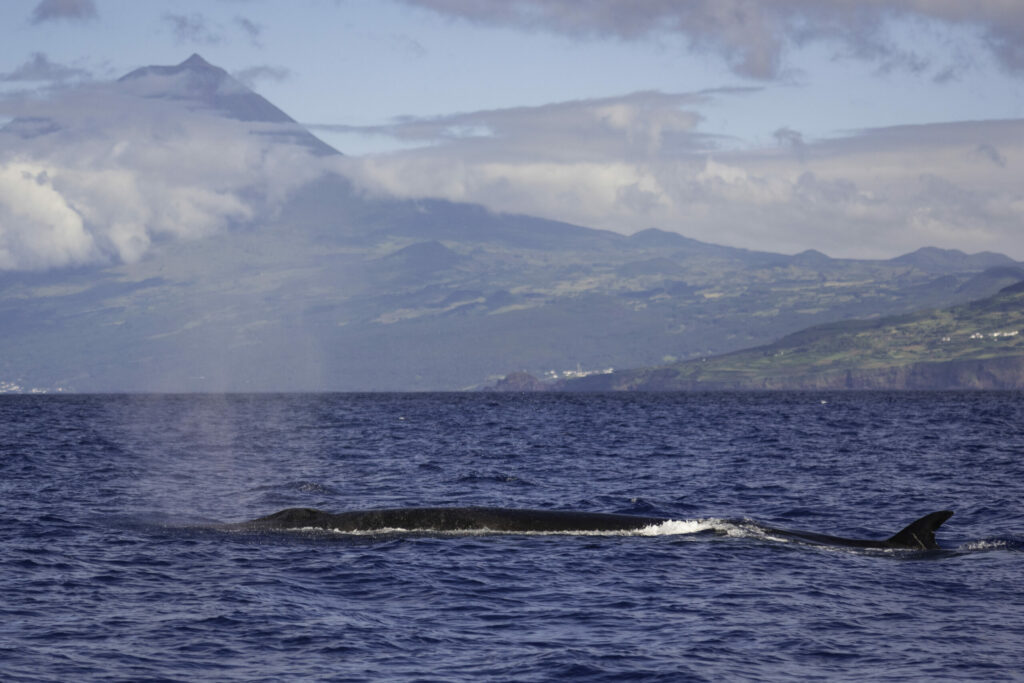
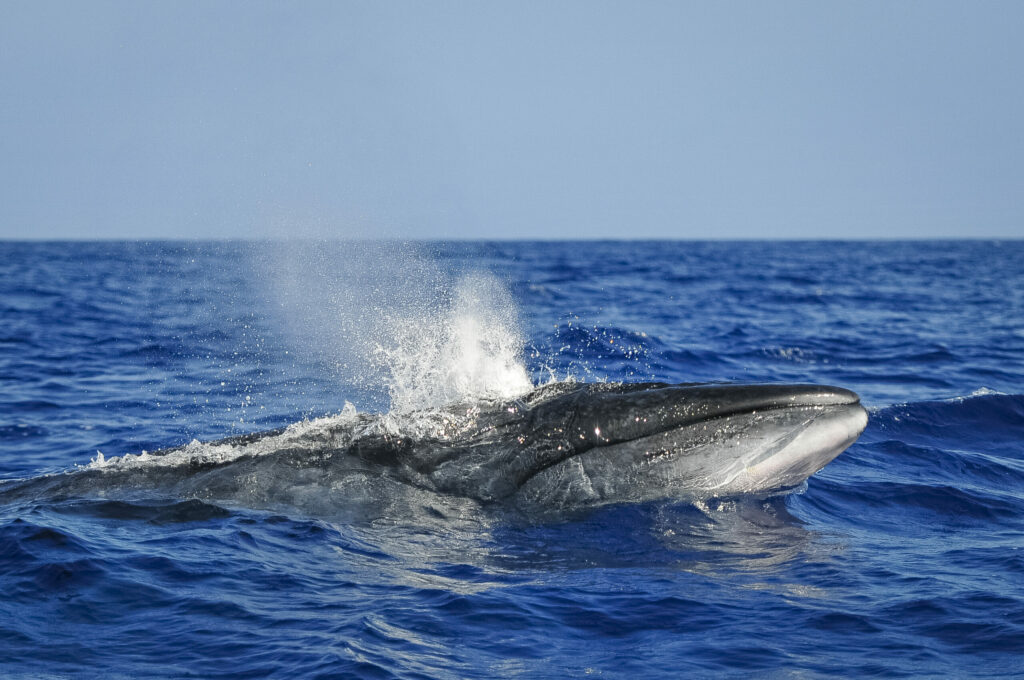
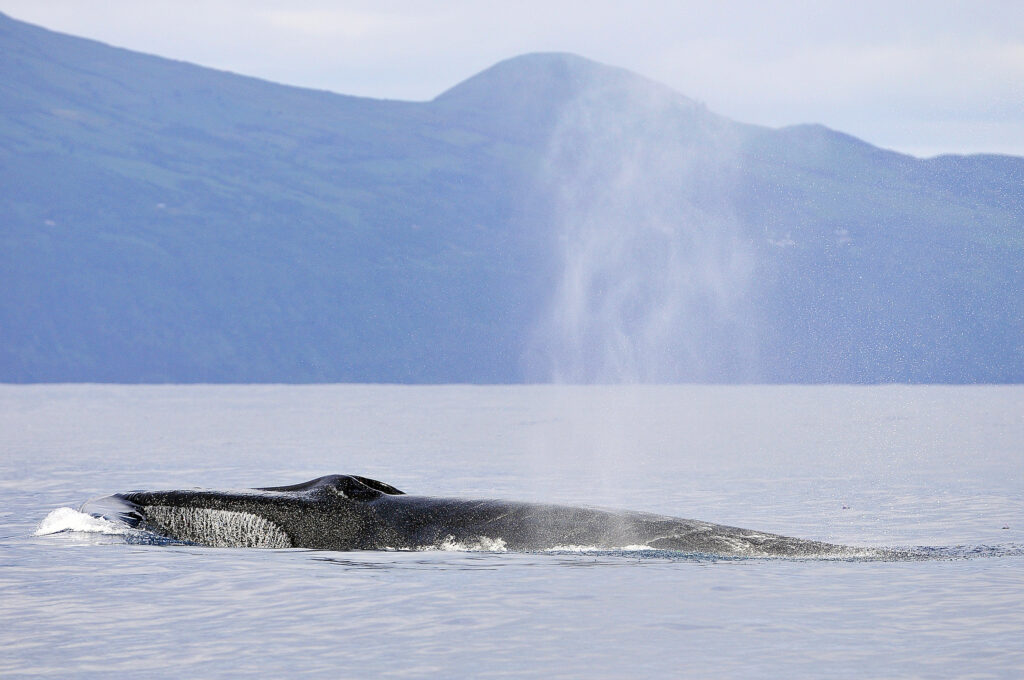
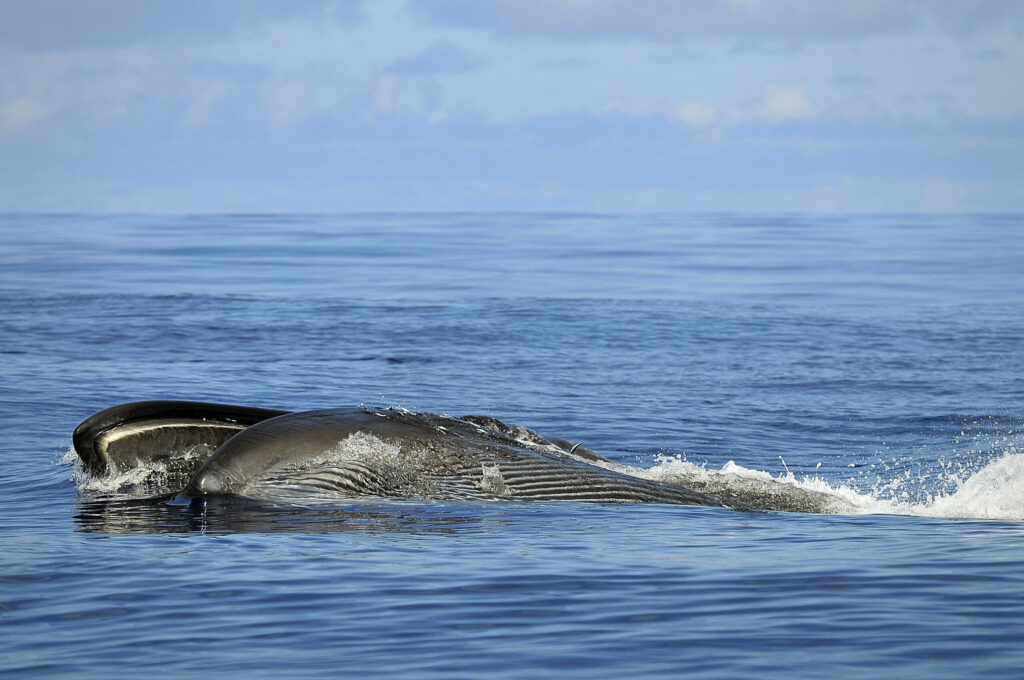
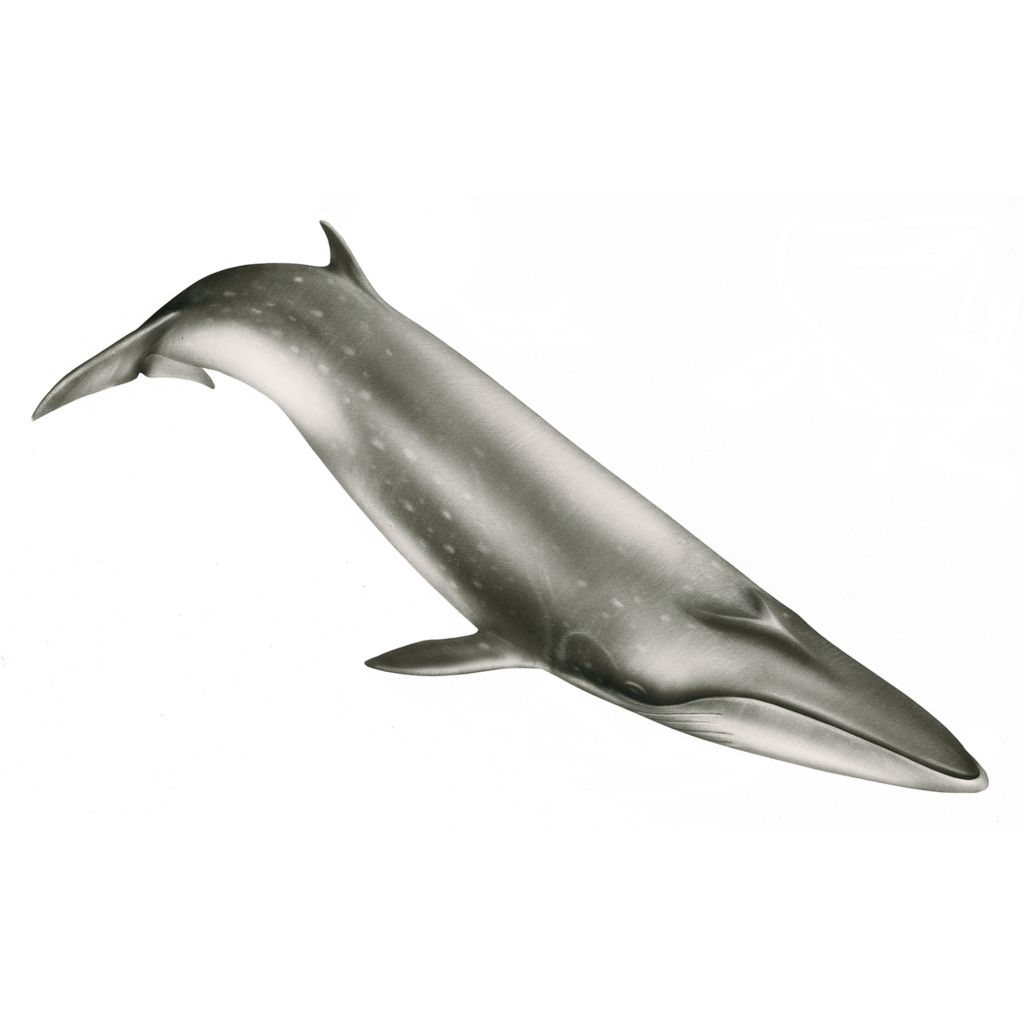
The Sei whale has a long, streamlined body, predominantly dark grey or bluish-grey, with a white underside often showing circular scars from lampreys or cookie-cutter sharks. A single longitudinal ridge runs along the midline of the head. The dorsal fin is tall, falcate, and positioned relatively far forward (about two-thirds of the way down the back) compared to other rorquals. Unlike Finn or Bryde's whales, their 32 to 62 ventral pleats are short, usually ending just behind the pectoral fins.
Sei whales produce a tall (~3 m) columnar blow. When diving, they do not arch their backs as steeply as other great whales. Their movement often leaves "flukeprints"—circular smooth patches on the water surface caused by the turbulence of their tails, even when they don't break the surface.
They are versatile feeders, consuming small schooling fish, squid, and krill, but they are also specialized in "skimming" for copepods. Group sizes are typically small, and their migration patterns between high-latitude summer feeding grounds and tropical winter breeding areas remain less understood than those of other species.
The Sei whale has a long, streamlined body, predominantly dark grey or bluish-grey, with a white underside often showing circular scars from lampreys or cookie-cutter sharks. A single longitudinal ridge runs along the midline of the head. The dorsal fin is tall, falcate, and positioned relatively far forward (about two-thirds of the way down the back) compared to other rorquals. Unlike Finn or Bryde's whales, their 32 to 62 ventral pleats are short, usually ending just behind the pectoral fins.
Sei whales produce a tall (~3 m) columnar blow. When diving, they do not arch their backs as steeply as other great whales. Their movement often leaves "flukeprints"—circular smooth patches on the water surface caused by the turbulence of their tails, even when they don't break the surface.
They are versatile feeders, consuming small schooling fish, squid, and krill, but they are also specialized in "skimming" for copepods. Group sizes are typically small, and their migration patterns between high-latitude summer feeding grounds and tropical winter breeding areas remain less understood than those of other species.
observation
Sei whales are found in all oceans, from subtropical to high latitudes, preferring open ocean and deep waters. They are globally famous for their unpredictable occurrences, often appearing in large numbers in an area for a season (known in Portugal as "anos de baleia-sardinheira") only to be absent for years.
Identification Challenges:
Vs. Fin Whale (Balaenoptera physalus): Fin whales are larger and possess a unique asymmetrical coloration (white on the right lower jaw).
Vs. Bryde’s Whale (Balaenoptera edeni): At close range, Bryde’s whales are easily distinguished by the three longitudinal ridges on their head, whereas the Sei whale has only one. Additionally, Bryde's whales arch their backs more aggressively when diving.
In the Azores, this is a seasonally frequent species, recorded in about 5% of Espaço Talassa’s trips. They typically migrate through the islands later than other large rorquals, with sightings starting in April and peaking in May and early June.
Identification Challenges:
Vs. Fin Whale (Balaenoptera physalus): Fin whales are larger and possess a unique asymmetrical coloration (white on the right lower jaw).
Vs. Bryde’s Whale (Balaenoptera edeni): At close range, Bryde’s whales are easily distinguished by the three longitudinal ridges on their head, whereas the Sei whale has only one. Additionally, Bryde's whales arch their backs more aggressively when diving.
In the Azores, this is a seasonally frequent species, recorded in about 5% of Espaço Talassa’s trips. They typically migrate through the islands later than other large rorquals, with sightings starting in April and peaking in May and early June.
names
PT: Baleia-sardinheira
AZORES: Sardinheira (Note: Finbeque is traditionally used for the Fin Whale)
ENG: Sei whale
FR: Rorqual boréal
DE: Seiwal
IT: Balenottera boreale
ESP: Rorcual norteño
NL: Noordse vinvis
AZORES: Sardinheira (Note: Finbeque is traditionally used for the Fin Whale)
ENG: Sei whale
FR: Rorqual boréal
DE: Seiwal
IT: Balenottera boreale
ESP: Rorcual norteño
NL: Noordse vinvis
Scientific name
Balaenoptera borealis
Discovery
Lesson, 1828