
True’s beaked whale
Mesoplodon mirus
biology
True’s beaked whales reach lengths of 4.9 m to 5.3 m and weigh between 1 and 1.5 tonnes. At birth, calves are estimated to be about 2.3 m long. Frederick True, the American biologist who first described the species in 1913, gave it the scientific name mirus, which means "wonderful."
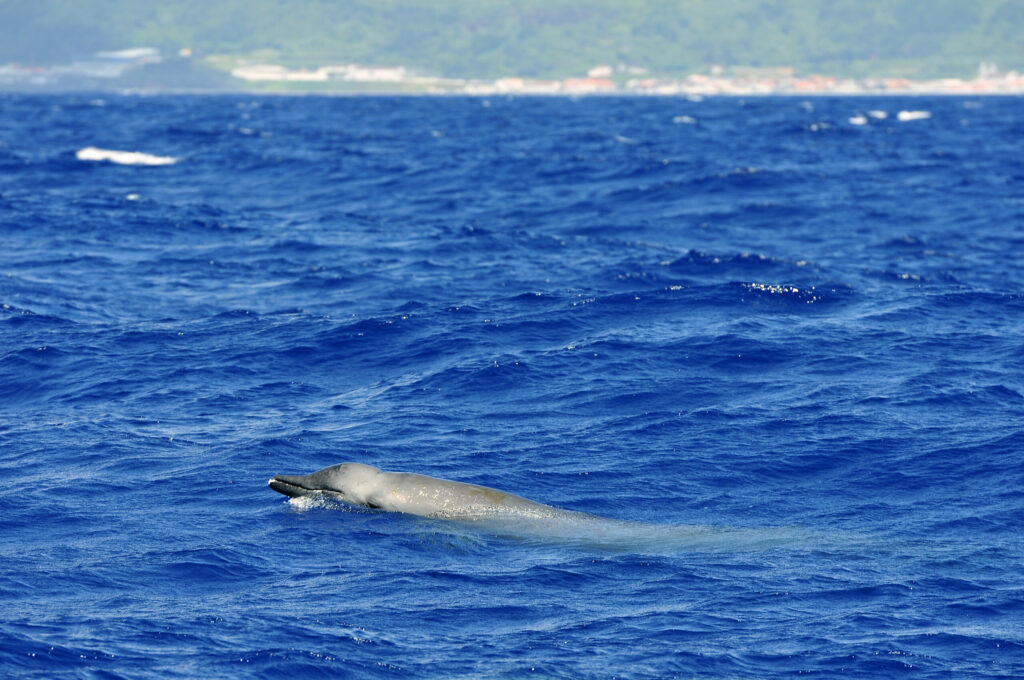
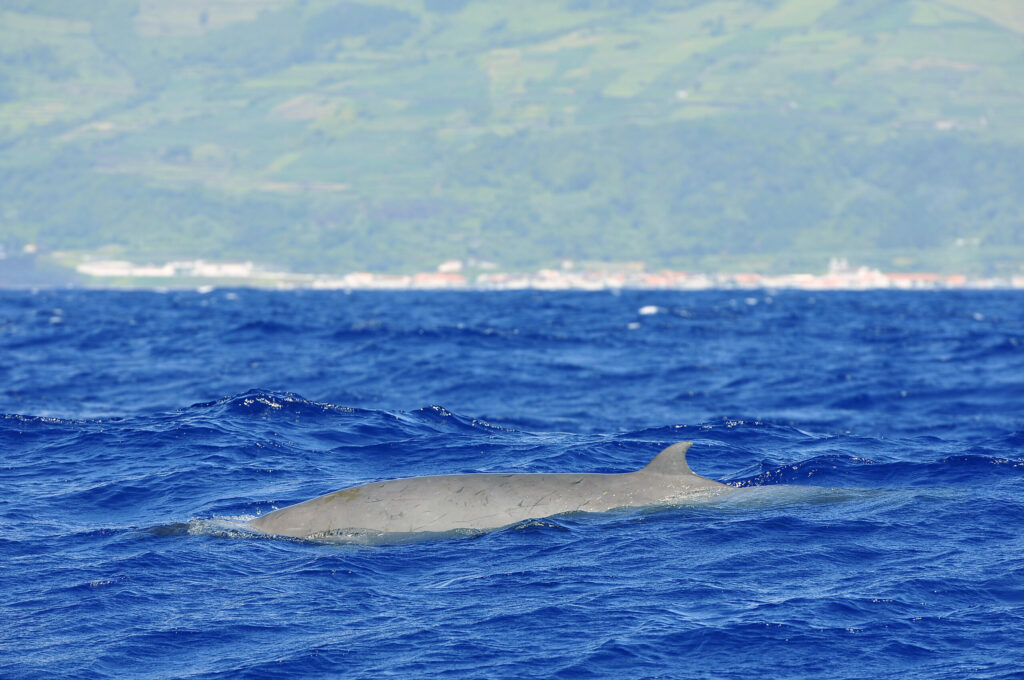
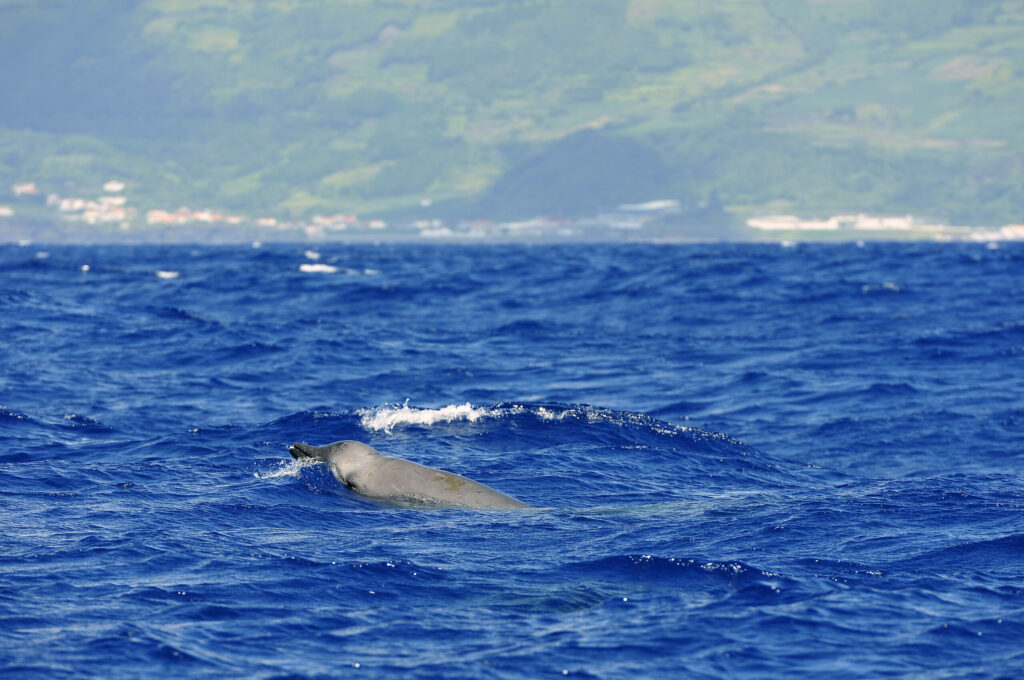
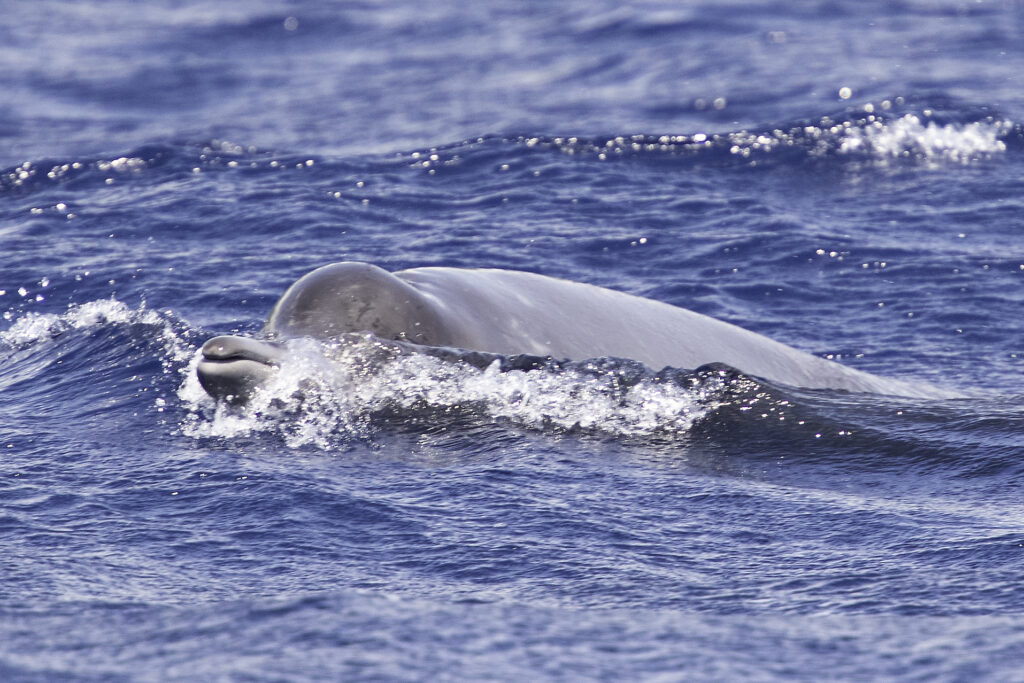
This species has a spindle-shaped body with a moderately short beak and a slightly bulbous melon. The mouthline is relatively straight. Their coloration follows a basic countershading pattern: dark bluish-grey on the back and lighter on the belly, often with a distinctive dark ring around the eye. Adult males are uniquely characterized by two small teeth located at the very tip of the lower jaw, which are slightly tilted forward. While Cuvier's beaked whales also have teeth at the tip, True’s is significantly smaller and lacks the pale/white head typical of older Cuvier's. Interestingly, they appear to show less body scarring compared to more aggressive species like Blainville’s or Sowerby’s beaked whales.
Like other members of the Mesoplodon genus, they feed primarily on squid and occasionally on deep-water fish. Because they were only identified in the wild relatively recently, their social structure is still a mystery. Groups observed at sea are typically small, consisting of 3 to 6 individuals.
This species has a spindle-shaped body with a moderately short beak and a slightly bulbous melon. The mouthline is relatively straight. Their coloration follows a basic countershading pattern: dark bluish-grey on the back and lighter on the belly, often with a distinctive dark ring around the eye. Adult males are uniquely characterized by two small teeth located at the very tip of the lower jaw, which are slightly tilted forward. While Cuvier's beaked whales also have teeth at the tip, True’s is significantly smaller and lacks the pale/white head typical of older Cuvier's. Interestingly, they appear to show less body scarring compared to more aggressive species like Blainville’s or Sowerby’s beaked whales.
Like other members of the Mesoplodon genus, they feed primarily on squid and occasionally on deep-water fish. Because they were only identified in the wild relatively recently, their social structure is still a mystery. Groups observed at sea are typically small, consisting of 3 to 6 individuals.
observation
True’s beaked whales are primarily found in temperate waters of the North Atlantic, often associated with the Gulf Stream. At sea, they are notoriously difficult to distinguish from other beaked whales. Without the presence of an adult male showing his "tusks," they are almost impossible to differentiate from Gervais' beaked whales (Mesoplodon europaeus).
In the Azores, sightings are extremely rare and prizes for any whale watcher. While they may have been spotted in the past, the Espaço Talassa team only began to formally recognize and record this species in 2016. Most sightings of beaked whales in the archipelago occur during the summer season, between early June and late August, when the sea is calmest.
In the Azores, sightings are extremely rare and prizes for any whale watcher. While they may have been spotted in the past, the Espaço Talassa team only began to formally recognize and record this species in 2016. Most sightings of beaked whales in the archipelago occur during the summer season, between early June and late August, when the sea is calmest.
names
PT: Zífio-de-true (ou Baleia-de-bico-de-true)
ENG: True’s beaked whale (or Wonderful beaked whale)
FR: Baleine à bec de True
DE: True-Zweizahnwal
IT: Mesoplodonte di True
ESP: Zifio de True
NL: Spitssnuitdolfijn van True
ENG: True’s beaked whale (or Wonderful beaked whale)
FR: Baleine à bec de True
DE: True-Zweizahnwal
IT: Mesoplodonte di True
ESP: Zifio de True
NL: Spitssnuitdolfijn van True
Scientific name
Mesoplodon mirus
Discovery
True, 1913