
North Atlantic right whale
Eubalaena glacialis
biology
Newborn North Atlantic right whales are about 4.5 m to 6 m long and weigh approximately 1 tonne. Adults are massive, typically measuring 11–18 m and weighing between 30 and 80 tonnes (with exceptional records up to 90 tonnes). They possess 220 to 260 long (up to 3 m), narrow black baleen plates per side. Their lifespan is known to exceed 70 years, and they are among the most endangered of all large whales.
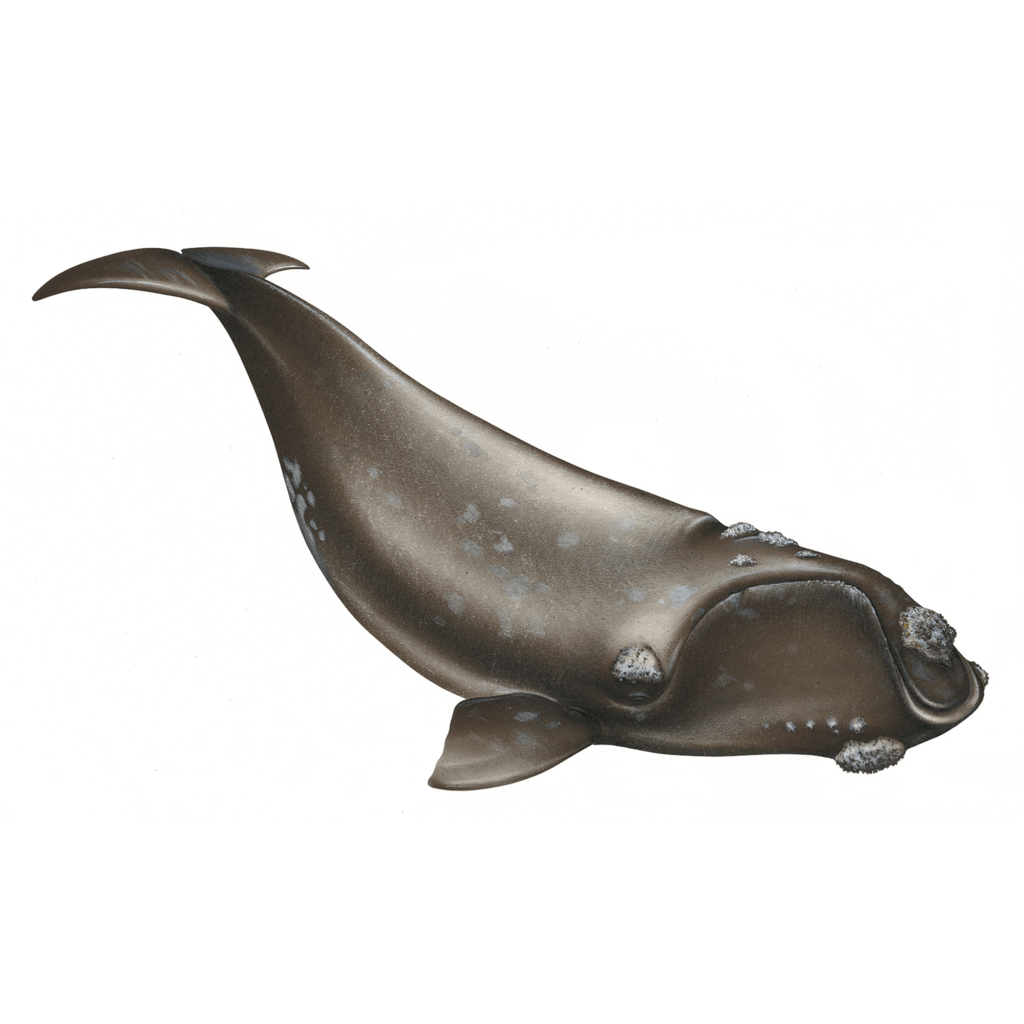
The right whale’s robust, black body is immediately recognizable by the total lack of a dorsal fin. They have exceptionally wide backs, paddle-shaped flippers, and a large head with a strongly arched mouthline. The head is covered in callosities—patches of thickened skin that appear white or yellowish because they are inhabited by "whale lice" (cyamids). Their flukes are large, triangular, and smooth-edged. One of their most distinctive features is the V-shaped blow, which can reach 5 m in height and is easily identified from a distance.
These whales are slow swimmers and feed exclusively on plankton (primarily copepods and krill) by skimming through the water with their mouths open. They are generally solitary or found in small groups. Despite their size, they can be remarkably active, performing breaches, tail slaps, and "head-stands." They are often curious about boats, a trait that historically made them the "right" whale to hunt.
The right whale’s robust, black body is immediately recognizable by the total lack of a dorsal fin. They have exceptionally wide backs, paddle-shaped flippers, and a large head with a strongly arched mouthline. The head is covered in callosities—patches of thickened skin that appear white or yellowish because they are inhabited by "whale lice" (cyamids). Their flukes are large, triangular, and smooth-edged. One of their most distinctive features is the V-shaped blow, which can reach 5 m in height and is easily identified from a distance.
These whales are slow swimmers and feed exclusively on plankton (primarily copepods and krill) by skimming through the water with their mouths open. They are generally solitary or found in small groups. Despite their size, they can be remarkably active, performing breaches, tail slaps, and "head-stands." They are often curious about boats, a trait that historically made them the "right" whale to hunt.
observation
Today, the North Atlantic right whale is primarily found in coastal and shelf waters along the eastern seaboard of North America (from Florida to Canada). The species is Critically Endangered, and is now functionally extinct in European waters, where it was once abundant during the medieval whaling era (when it was known as the "Biscayan Right Whale").
In the Azores, this species is an extremely rare visitor. While it hasn't been a regular part of Espaço Talassa’s daily sightings, a historic event occurred on January 5, 2009: an adult female (approx. 15 m long) was spotted south of Pico. Identified as individual “3270” (nicknamed "Pico") from the North Atlantic Right Whale Catalogue, she had travelled at least 3,320 km from the Bay of Fundy (Canada) in just 101 days. This was the first confirmed record of the species in the Azores since 1888, the year the last right whale was hunted in the archipelago.
In the Azores, this species is an extremely rare visitor. While it hasn't been a regular part of Espaço Talassa’s daily sightings, a historic event occurred on January 5, 2009: an adult female (approx. 15 m long) was spotted south of Pico. Identified as individual “3270” (nicknamed "Pico") from the North Atlantic Right Whale Catalogue, she had travelled at least 3,320 km from the Bay of Fundy (Canada) in just 101 days. This was the first confirmed record of the species in the Azores since 1888, the year the last right whale was hunted in the archipelago.
names
PT: Baleia-franca-do-Atlântico-Norte
AZORES: Raituel (Note: A beautiful local corruption of the English "Right Whale")
ENG: North Atlantic right whale
FR: Baleine franche de l’Atlantique nord
DE: Atlantischer Nordkaper
IT: Balena franca nordatlantica
ESP: Ballena franca glacial (ou vizcaína)
NL: Noordkaper
AZORES: Raituel (Note: A beautiful local corruption of the English "Right Whale")
ENG: North Atlantic right whale
FR: Baleine franche de l’Atlantique nord
DE: Atlantischer Nordkaper
IT: Balena franca nordatlantica
ESP: Ballena franca glacial (ou vizcaína)
NL: Noordkaper
Scientific name
Eubalaena glacialis
Discovery
Muller, 1776