




Rough toothed dolphin
Steno bredanensis
biology
Newborn rough-toothed dolphins are about 1 m long. Adults can grow to lengths of 2.1 m to 2.6 m and weigh approximately 150 kg. They typically possess 19 to 29 pairs of stout teeth in each jaw. These teeth feature unique vertical grooves or wrinkles, which give the species its name. Their lifespan is estimated to be at least 35 years.
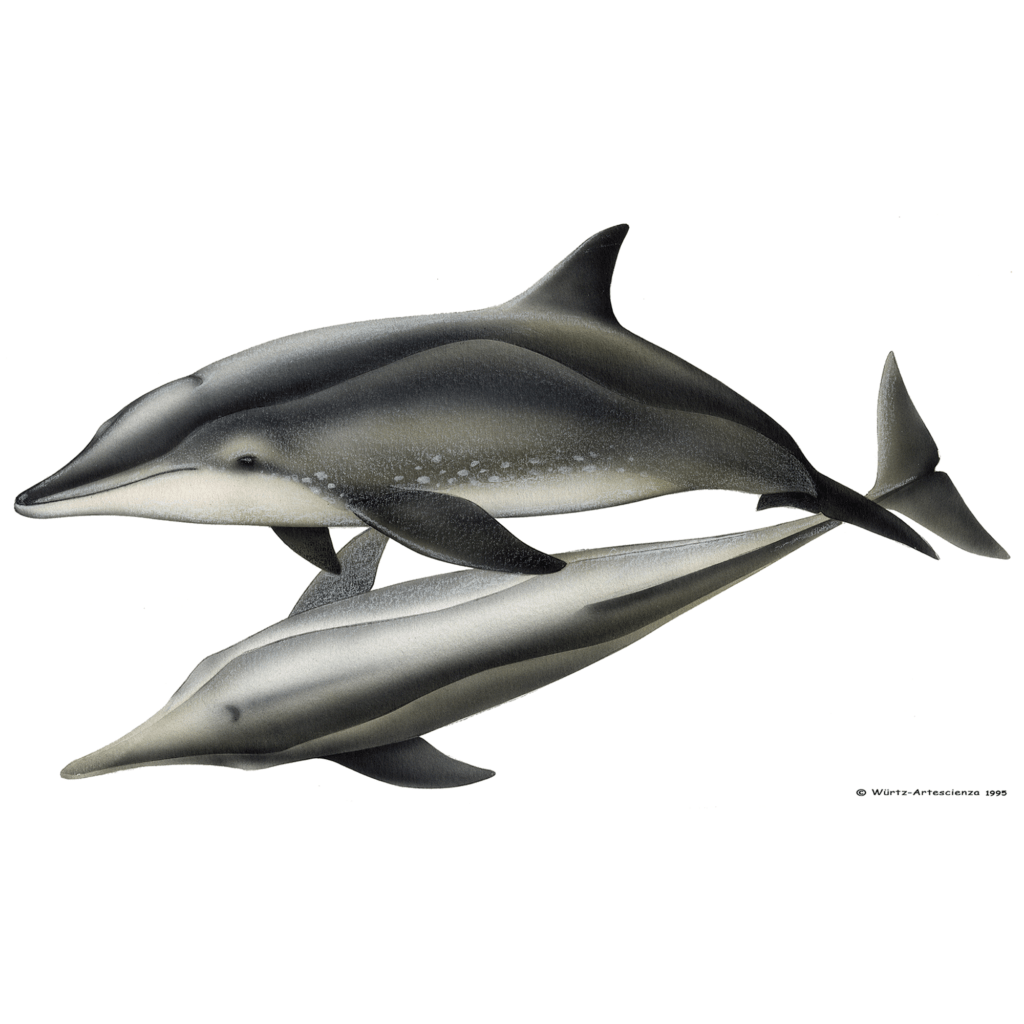
The rough-toothed dolphin is physically unique among long-beaked dolphins because it lacks a crease between the melon and the beak. Instead, the forehead slopes smoothly into the snout, giving it a tapered, reptilian profile. Their coloration is complex: a dark grey dorsal cape that narrows sharply between the blowhole and the fin, light grey flanks, and a white or pinkish belly. Older individuals are often covered in white or yellowish spots and scars, and the tip of the beak and jaws are frequently white, which stands out during surfacing.
They are versatile predators, known to feed on squid and large fish species, including Mahi-mahi (Dolphinfish). They have a very distinctive swimming style, moving at high speeds with their heads and chins consistently above the surface. While they can be shy, they are also known to bow-ride and perform spectacular, high-energy leaps.
The rough-toothed dolphin is physically unique among long-beaked dolphins because it lacks a crease between the melon and the beak. Instead, the forehead slopes smoothly into the snout, giving it a tapered, reptilian profile. Their coloration is complex: a dark grey dorsal cape that narrows sharply between the blowhole and the fin, light grey flanks, and a white or pinkish belly. Older individuals are often covered in white or yellowish spots and scars, and the tip of the beak and jaws are frequently white, which stands out during surfacing.
They are versatile predators, known to feed on squid and large fish species, including Mahi-mahi (Dolphinfish). They have a very distinctive swimming style, moving at high speeds with their heads and chins consistently above the surface. While they can be shy, they are also known to bow-ride and perform spectacular, high-energy leaps.
observation
This species is found in tropical and warm temperate waters worldwide, usually far offshore in deep oceanic environments.
Identification Tips: At a distance, they can be easily confused with Bottlenose dolphins (Tursiops truncatus) due to their size and dorsal fin shape. However, the Bottlenose has a much shorter, robust beak with a well-defined crease at the forehead. The rough-toothed dolphin’s long, sloping head profile and white-tipped beak are the best clues for a positive identification.
In the Azores, they are considered very rare visitors. After a long absence since 1995, the Espaço Talassa team recorded a group of 50 individuals in August 2010. More recently, in September 2016, a group of 20 to 40 individuals was encountered twice in the same day, exhibiting social behavior and bow-riding close to our vessels in a tight formation.
Identification Tips: At a distance, they can be easily confused with Bottlenose dolphins (Tursiops truncatus) due to their size and dorsal fin shape. However, the Bottlenose has a much shorter, robust beak with a well-defined crease at the forehead. The rough-toothed dolphin’s long, sloping head profile and white-tipped beak are the best clues for a positive identification.
In the Azores, they are considered very rare visitors. After a long absence since 1995, the Espaço Talassa team recorded a group of 50 individuals in August 2010. More recently, in September 2016, a group of 20 to 40 individuals was encountered twice in the same day, exhibiting social behavior and bow-riding close to our vessels in a tight formation.
names
PT: Golfinho-de-dentes-rugosos
AÇORES: Caldeirão
ENG: Rough-toothed dolphin
FR: Steno (ou Dauphin à bec rude)
DE: Rauzahndelfin
IT: Steno
ESP: Delfín de dientes rugosos
NL: Snaveldolfijn
AÇORES: Caldeirão
ENG: Rough-toothed dolphin
FR: Steno (ou Dauphin à bec rude)
DE: Rauzahndelfin
IT: Steno
ESP: Delfín de dientes rugosos
NL: Snaveldolfijn
Scientific name
Steno bredanensis
Discovery
Lesson, 1828