
Fraser’s dolphin
Lagenodelphis hosei
biology
Newborn Fraser’s dolphins are about 1 m long. Adults can grow to lengths of 2 m to 2.6 m and weigh between 160 and 210 kg, with males being slightly larger than females. They possess 38 to 44 pairs of teeth in each jaw. Interestingly, while the species was first described from a skeleton in Sarawak (Borneo) in 1956, it was only officially recognized alive at sea in 1971.
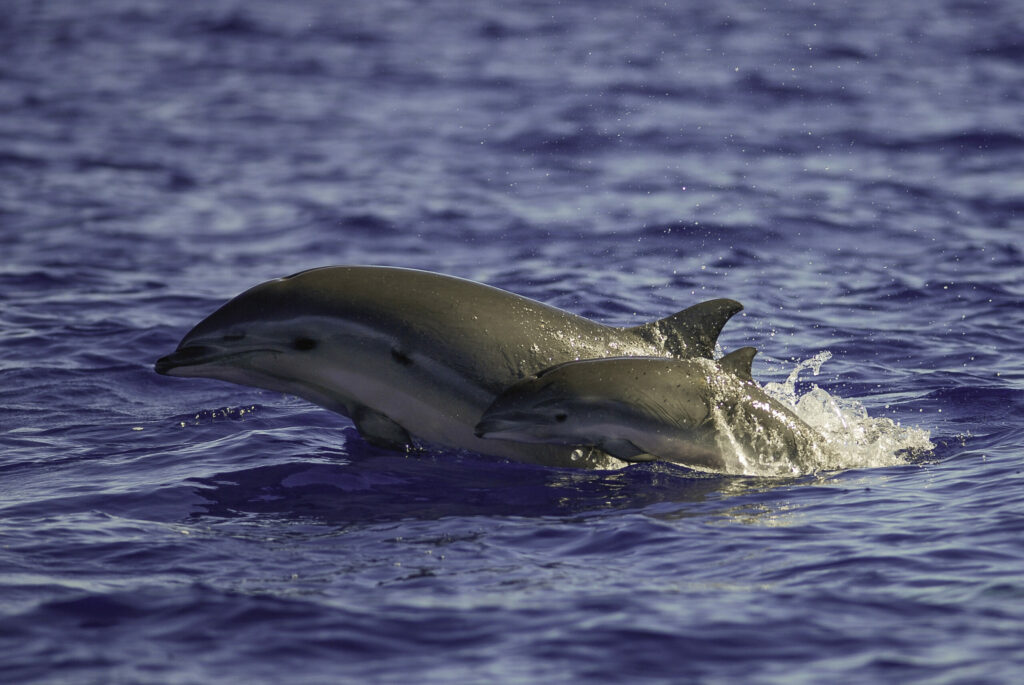
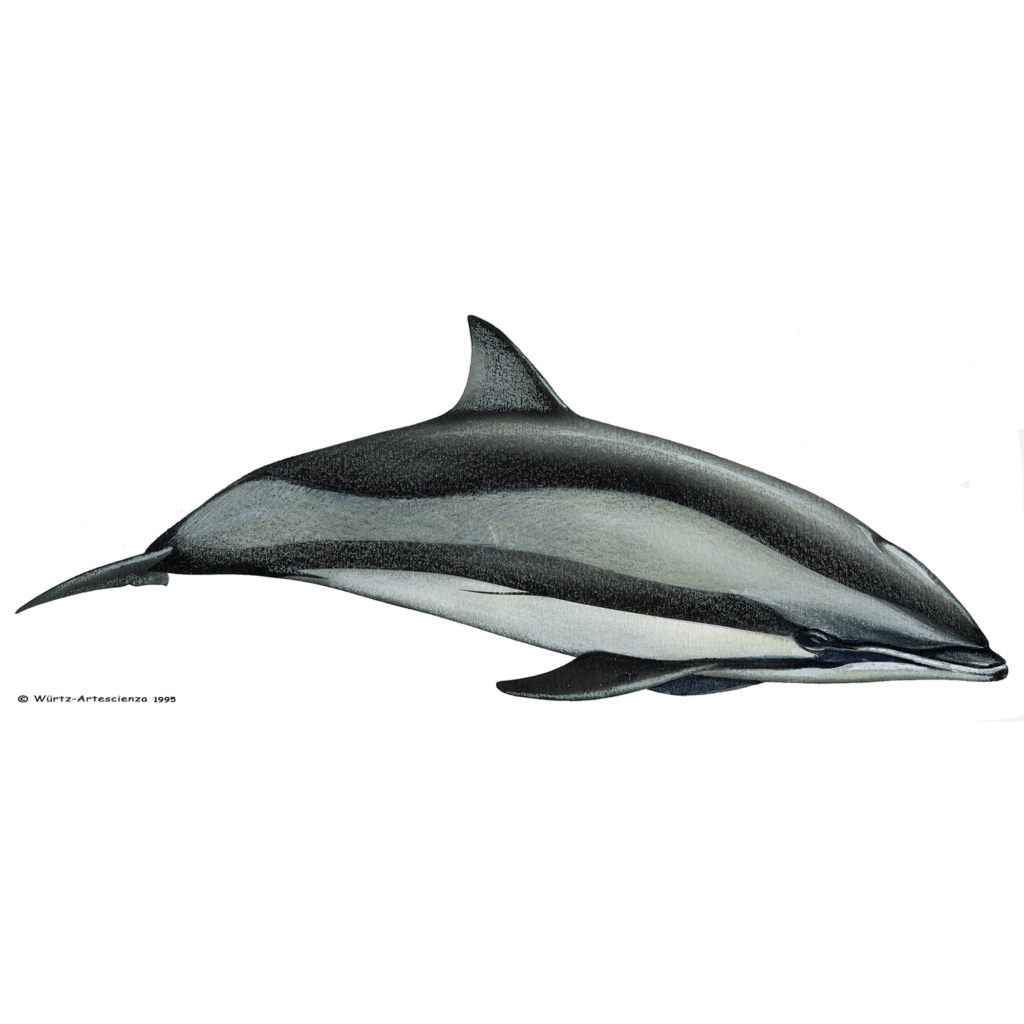
This dolphin has a notably robust, "stocky" body, a very short but well-defined beak, and small pectoral flippers. Its most striking feature is its unique "bandit mask" coloration: a broad, dark stripe running from the eye to the anus, and another parallel stripe from the throat to the flipper. The back is a dark bluish-grey, the flanks are cream-grey, and the belly is white or often pinkish. The dorsal fin is small and triangular, becoming more erect in adult males.
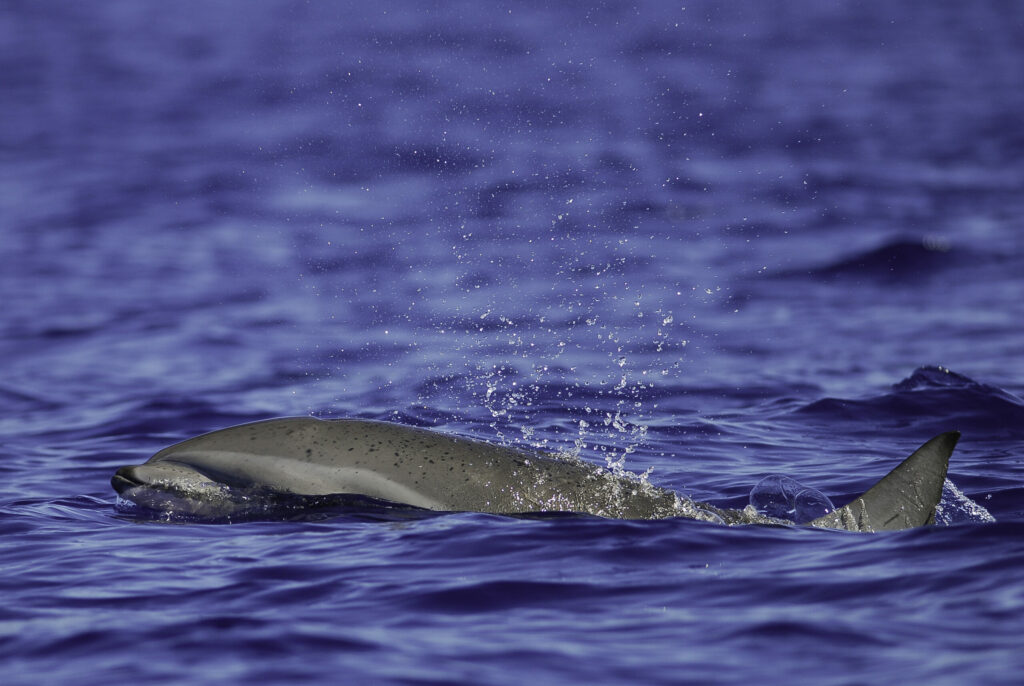
Fraser’s dolphins feed on mesopelagic fish, crustaceans, and cephalopods, and are capable of diving to depths of at least 600 m. They are highly social and typically travel in large, dense groups of 100 to 1,000 individuals. They are known for their fast, aggressive swimming style, performing low-angle, splashy jumps (porpoising) that create a significant amount of spray, often making them difficult to observe clearly.
This dolphin has a notably robust, "stocky" body, a very short but well-defined beak, and small pectoral flippers. Its most striking feature is its unique "bandit mask" coloration: a broad, dark stripe running from the eye to the anus, and another parallel stripe from the throat to the flipper. The back is a dark bluish-grey, the flanks are cream-grey, and the belly is white or often pinkish. The dorsal fin is small and triangular, becoming more erect in adult males.
Fraser’s dolphins feed on mesopelagic fish, crustaceans, and cephalopods, and are capable of diving to depths of at least 600 m. They are highly social and typically travel in large, dense groups of 100 to 1,000 individuals. They are known for their fast, aggressive swimming style, performing low-angle, splashy jumps (porpoising) that create a significant amount of spray, often making them difficult to observe clearly.
observation
Fraser’s dolphins have a pantropical distribution, preferring deep oceanic waters. Because of their "bandit mask" and size, they can be confused at a distance with Striped dolphins (Stenella coeruleoalba). However, the Fraser’s dolphin is much more robust, has a significantly shorter beak, and its side stripe is far broader.
In the Azores, they are considered extremely rare visitors. Their presence is episodic and usually associated with years of higher sea surface temperatures or unusual warm currents. The Espaço Talassa team has recorded this species on only two occasions, both in August 2008. The first group was shy and difficult to approach, while the second group of about 50 individuals was highly active and engaged in bow-riding.
In the Azores, they are considered extremely rare visitors. Their presence is episodic and usually associated with years of higher sea surface temperatures or unusual warm currents. The Espaço Talassa team has recorded this species on only two occasions, both in August 2008. The first group was shy and difficult to approach, while the second group of about 50 individuals was highly active and engaged in bow-riding.
names
PT: Golfinho-de-fraser
ENG: Fraser’s dolphin (or Sarawak dolphin)
FR: Dauphin de Fraser
DE: Borneodelfin (ou Fraser-Delfin)
IT: Lagenodelfino
ESP: Delfín de Fraser
NL: Sarawakdolfijn (ou Frasers dolfijn)
ENG: Fraser’s dolphin (or Sarawak dolphin)
FR: Dauphin de Fraser
DE: Borneodelfin (ou Fraser-Delfin)
IT: Lagenodelfino
ESP: Delfín de Fraser
NL: Sarawakdolfijn (ou Frasers dolfijn)
Scientific name
Lagenodelphis hosei
Discovery
Fraser, 1956