
Fin whale
Balaenoptera physalus
biology
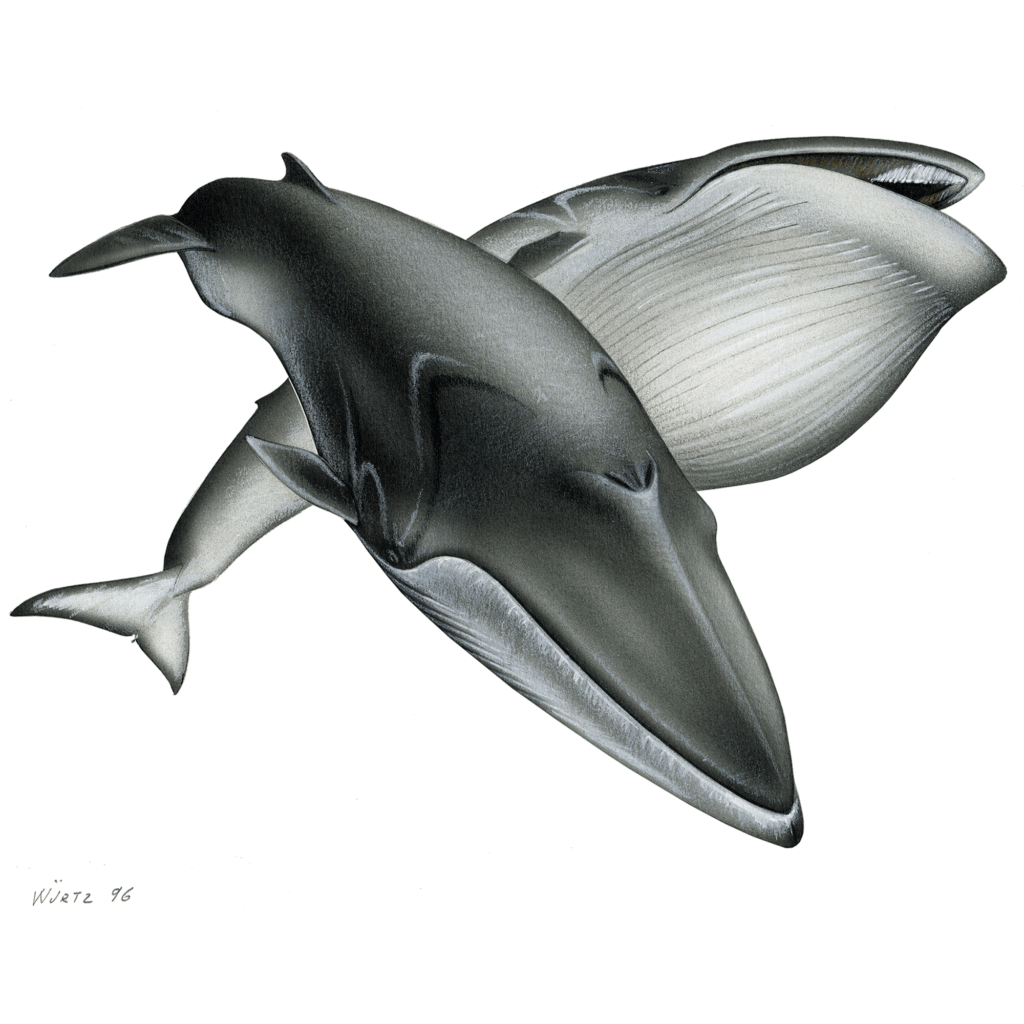
Newborn fin whales are about 6 to 6.5 m long. In the Northern Hemisphere, adults typically reach lengths of 18–22 m (with Southern Hemisphere individuals reaching up to 26 m), making them the second-largest animal on the planet. Unlike the bulkier Blue whale, Fin whales have a very slender and hydrodynamic body, with weights typically ranging from 30 to 80 tonnes. They have 260 to 480 baleen plates per side; these are dark grey to black, except for the front third of the right side, which are cream or white. Their lifespan can exceed 80 to 90 years.
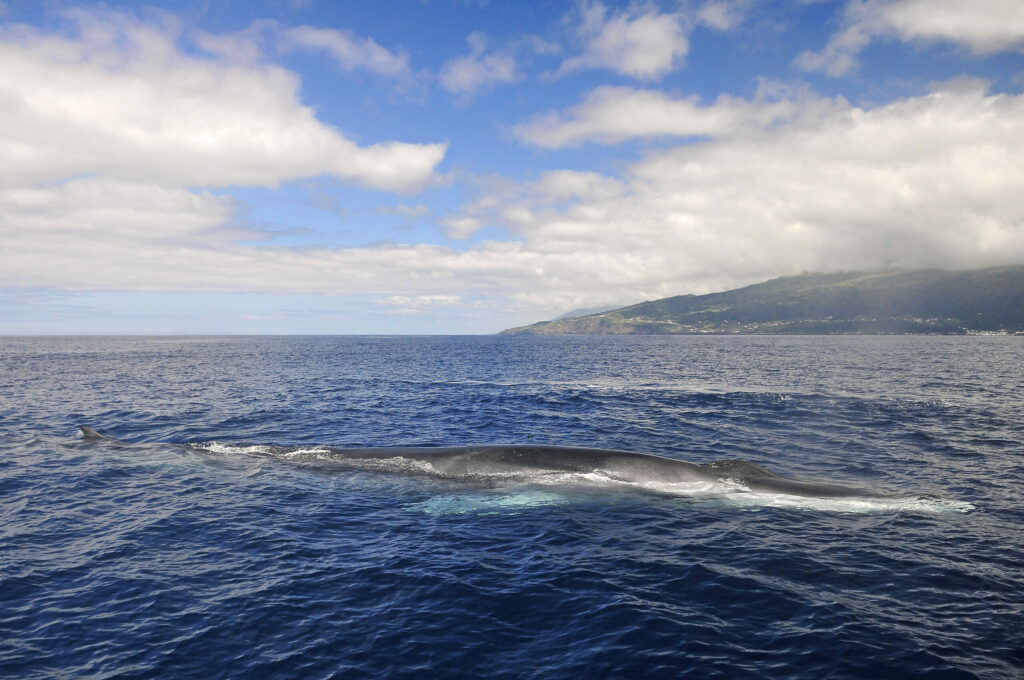
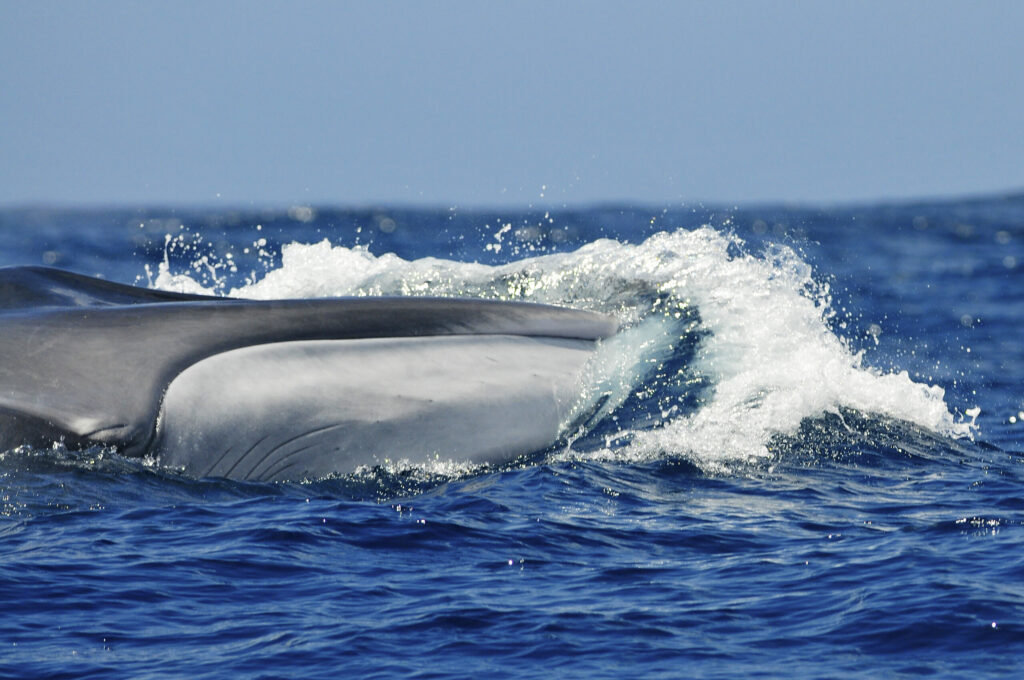
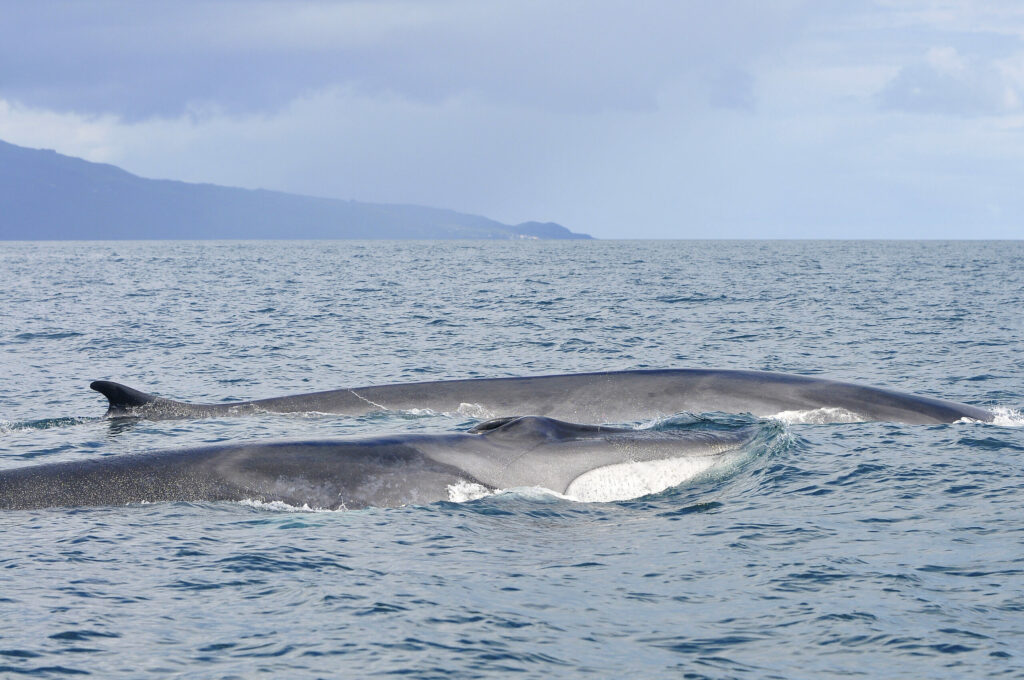
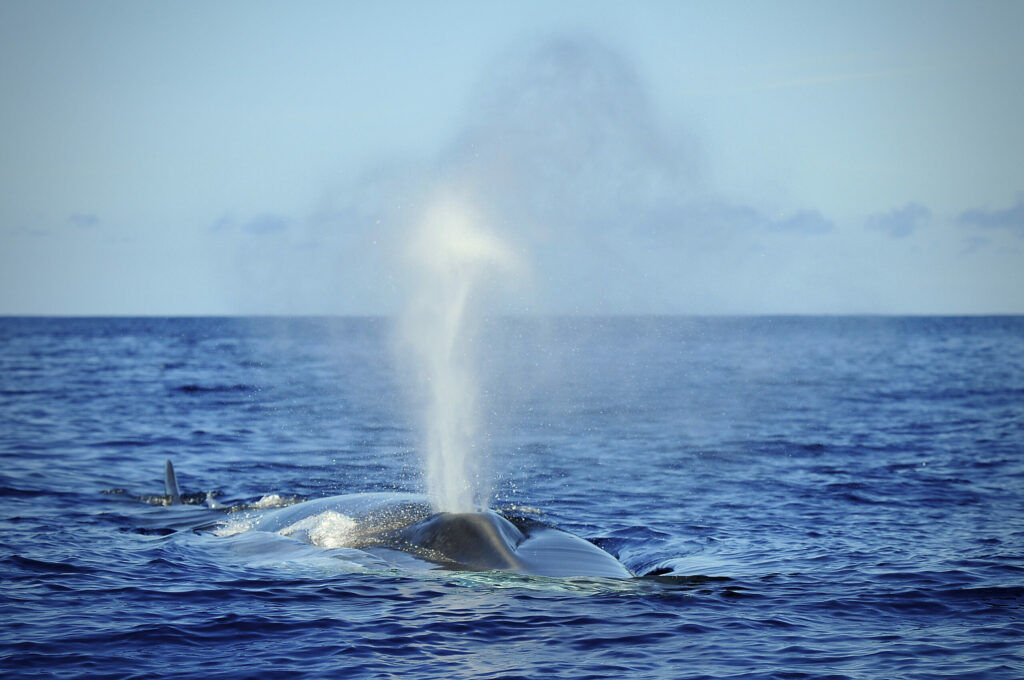
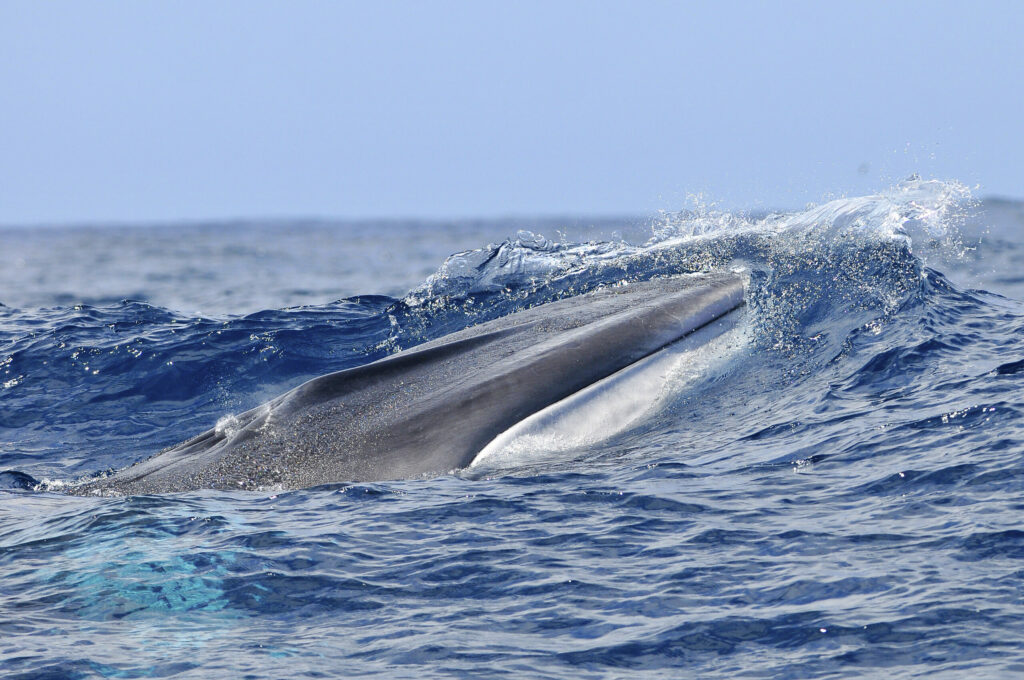
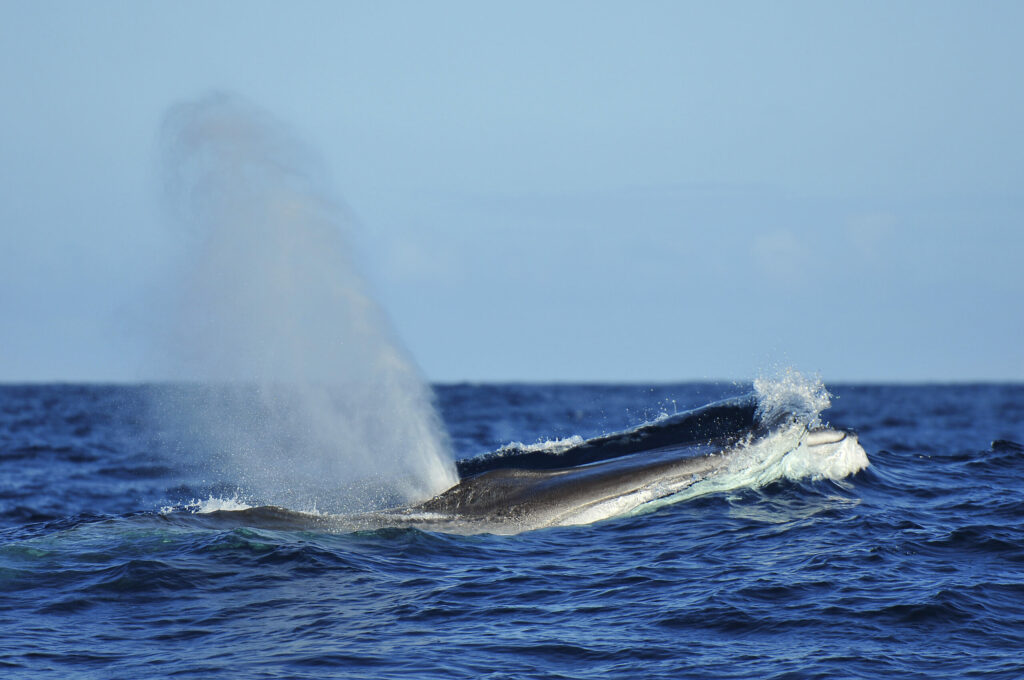
Fin whales are easily identified by their unique asymmetrical coloration: the lower right jaw, the inside of the mouth, and the front baleen on the right are white, while the left side is uniformly dark grey. They also feature a light grey "chevron" (blaze) behind the head, which is more prominent on the right side. From above, the head is V-shaped and flat. They have 56 to 100 ventral pleats extending to the umbilicus. The dorsal fin is tall, falcate, and set far back; because of this, the blow and the dorsal fin are rarely seen at the surface simultaneously. The blow is a tall, narrow column reaching 4 to 6 m in height.
Known as the "greyhounds of the sea," they can reach sustained speeds of 15 knots, with bursts of up to 25 knots (~40 km/h) when lunging for prey. They feed on krill and small schooling fish. It is extremely rare for them to raise their flukes during a dive. While they are often seen alone or in small groups, large aggregations may form in rich feeding grounds. Hybrids between Blue (Balaenoptera musculus) and Fin whales are occasionally documented.
Fin whales are easily identified by their unique asymmetrical coloration: the lower right jaw, the inside of the mouth, and the front baleen on the right are white, while the left side is uniformly dark grey. They also feature a light grey "chevron" (blaze) behind the head, which is more prominent on the right side. From above, the head is V-shaped and flat. They have 56 to 100 ventral pleats extending to the umbilicus. The dorsal fin is tall, falcate, and set far back; because of this, the blow and the dorsal fin are rarely seen at the surface simultaneously. The blow is a tall, narrow column reaching 4 to 6 m in height.
Known as the "greyhounds of the sea," they can reach sustained speeds of 15 knots, with bursts of up to 25 knots (~40 km/h) when lunging for prey. They feed on krill and small schooling fish. It is extremely rare for them to raise their flukes during a dive. While they are often seen alone or in small groups, large aggregations may form in rich feeding grounds. Hybrids between Blue (Balaenoptera musculus) and Fin whales are occasionally documented.
observation
Fin whales are a cosmopolitan species found in both coastal and oceanic waters. They are the only large rorqual frequently found in the Mediterranean Sea. At a distance, they can be confused with Blue whales, though the latter has a more mottled, lighter-colored body and a much smaller dorsal fin. Compared to Sei whales (Balaenoptera borealis), Fin whales are larger, and their dorsal fin appears significantly after the blow, whereas in the Sei whale, they are often visible at the same time.
In the Azores, this is a seasonally frequent species. Historically, they were seen in about 7% of Espaço Talassa tours, but since 2014, sightings have increased significantly, appearing in up to 35% of trips. This may reflect either a population recovery in the North Atlantic or a shift in migration routes closer to the coast of Pico. The main sighting window is between March and July, peaking in April and May. We often observe them in two states: feeding (erratic patterns, longer dives) or resting (travelling slowly near the surface, occasionally showing curiosity toward our boats).
In the Azores, this is a seasonally frequent species. Historically, they were seen in about 7% of Espaço Talassa tours, but since 2014, sightings have increased significantly, appearing in up to 35% of trips. This may reflect either a population recovery in the North Atlantic or a shift in migration routes closer to the coast of Pico. The main sighting window is between March and July, peaking in April and May. We often observe them in two states: feeding (erratic patterns, longer dives) or resting (travelling slowly near the surface, occasionally showing curiosity toward our boats).
names
PT: Baleia-comum
AZORES: Finbeque
ENG: Fin whale
FR: Rorqual commun
DE: Finnwal
IT: Balenottera comune
ESP: Rorcual común
NL: Gewone vinvis
AZORES: Finbeque
ENG: Fin whale
FR: Rorqual commun
DE: Finnwal
IT: Balenottera comune
ESP: Rorcual común
NL: Gewone vinvis
Scientific name
Balaenoptera physalus
Discovery
Linnaeus, 1758