

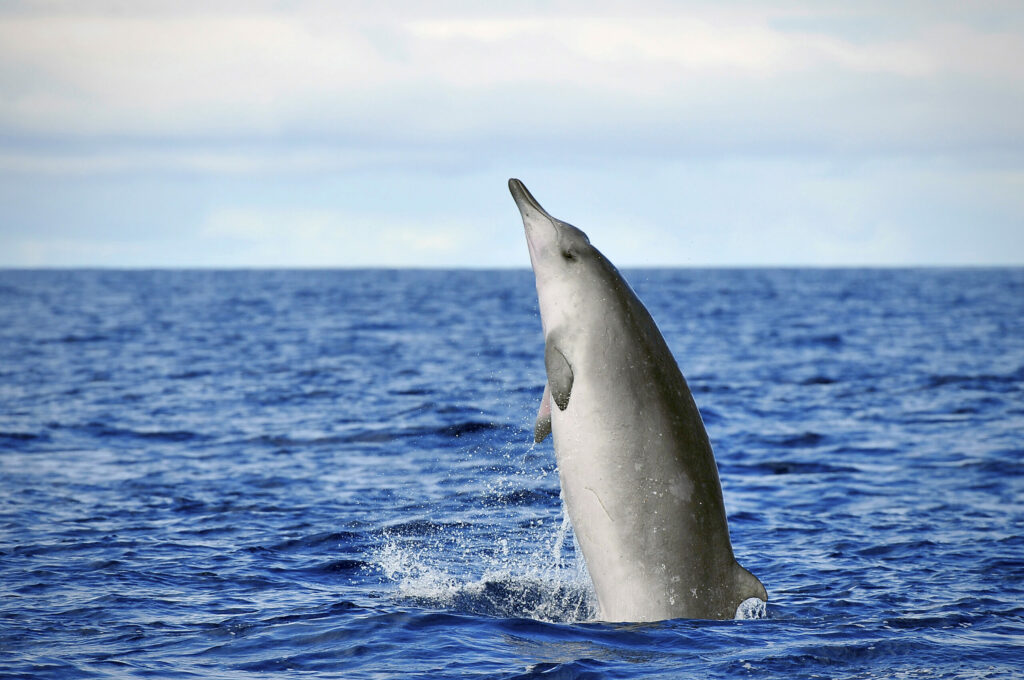
Sowerby’s beaked whale
Mesoplodon bidens
biology
Sowerby’s beaked whale holds a special place in cetology as the first beaked whale ever discovered, described in 1800 by the English artist James Sowerby. Newborns are about 2.4 m to 2.7 m long. Adults typically reach 4 m to 5 m (with males growing up to 5.5 m) and weigh between 1 and 1.3 tonnes.
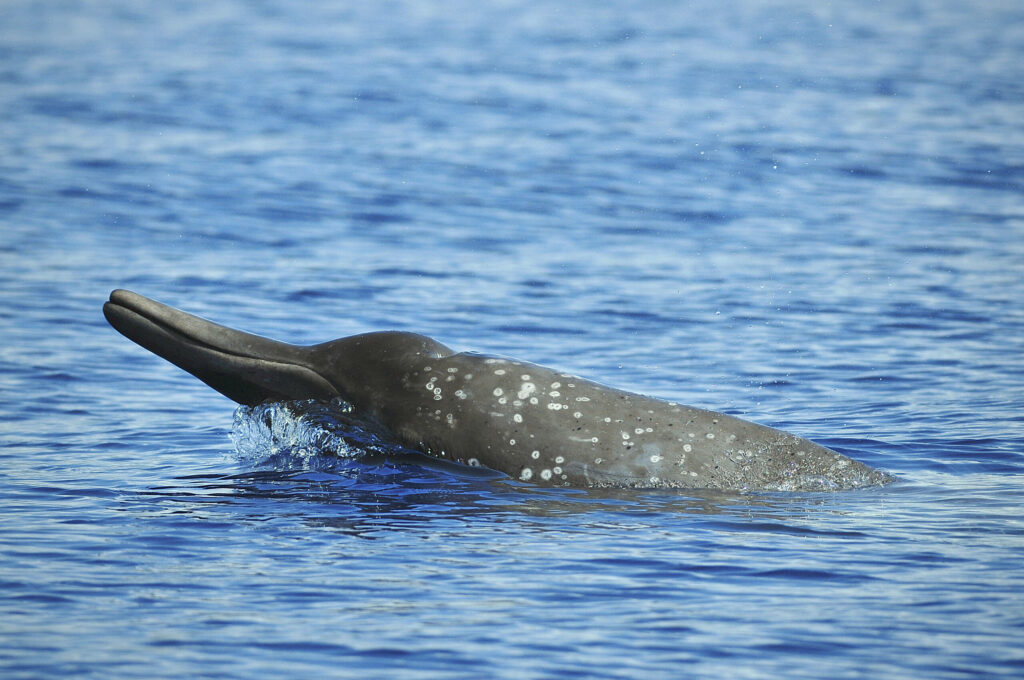
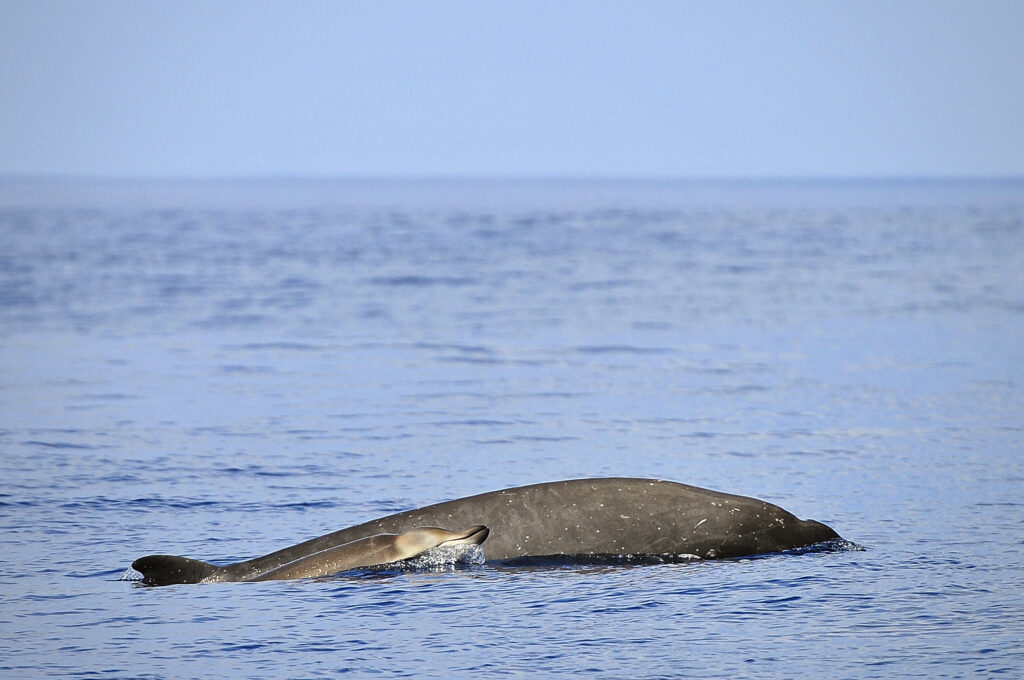
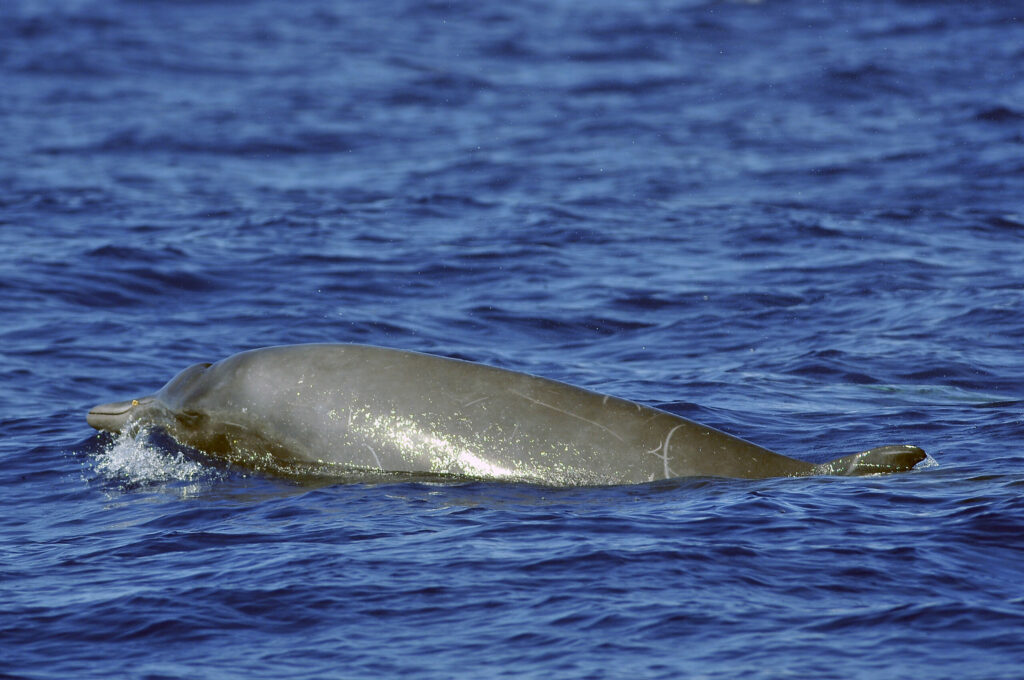
These whales have a classic spindle-shaped body, a notably long and slender beak, and a small dorsal fin set far back. A key identification feature is the prominent bulge on the forehead, just in front of the blowhole. In adult males, two teeth erupt midway along the mouthline (about 30 cm from the tip of the beak); while not massive, they are visible even when the mouth is closed. Their coloration is dark bluish-grey on the back and lighter on the belly. Adult males often exhibit extensive scarring from social competition.
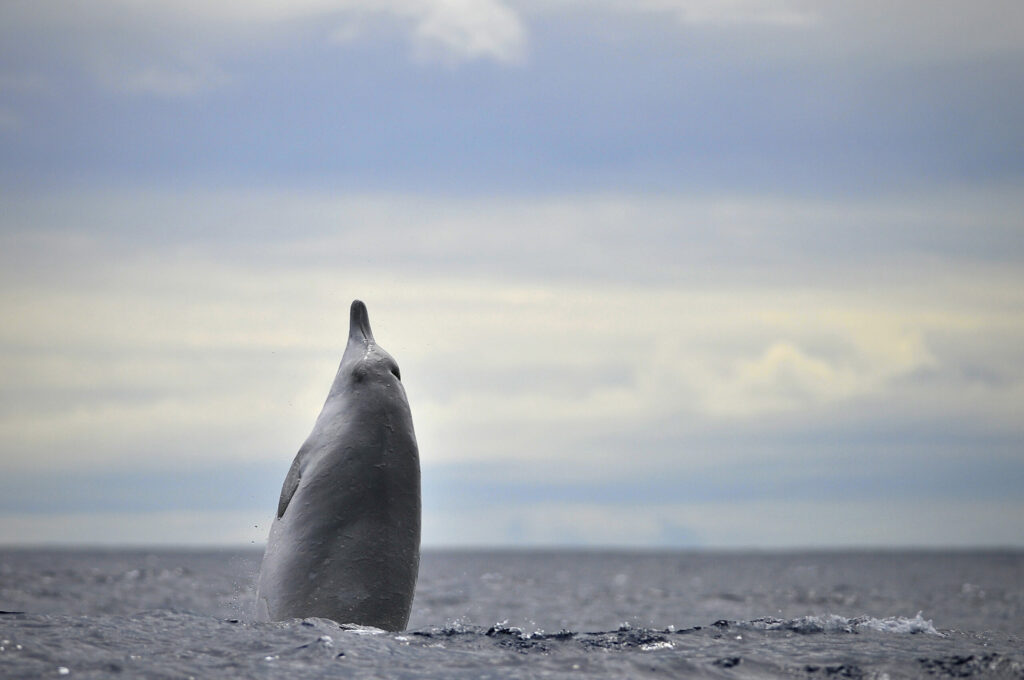
Presumed to feed primarily on squid, their diet also includes deep-water fish. They are social animals often found in groups of 8 to 10 individuals, which may include adult males, females, and calves. They are very active at the surface for a beaked whale, often bringing their heads out of the water at a steep angle during surfacing.
These whales have a classic spindle-shaped body, a notably long and slender beak, and a small dorsal fin set far back. A key identification feature is the prominent bulge on the forehead, just in front of the blowhole. In adult males, two teeth erupt midway along the mouthline (about 30 cm from the tip of the beak); while not massive, they are visible even when the mouth is closed. Their coloration is dark bluish-grey on the back and lighter on the belly. Adult males often exhibit extensive scarring from social competition.
Presumed to feed primarily on squid, their diet also includes deep-water fish. They are social animals often found in groups of 8 to 10 individuals, which may include adult males, females, and calves. They are very active at the surface for a beaked whale, often bringing their heads out of the water at a steep angle during surfacing.
observation
Sowerby’s beaked whale is endemic to the North Atlantic, ranging from the Norwegian Sea down to the Azores and Madeira.
Identification Tips: When surfacing, Sowerby’s beaked whales tend to expose more of their beak at a steeper angle compared to Gervais’ or True’s beaked whales. In adult males, the position of the teeth (midway along the jaw) is the final clue to distinguish them from other Mesoplodon species that have teeth right at the tip (True’s/Cuvier’s) or much further back (Blainville’s).
In the south of Pico, this is the most frequently sighted beaked whale species. While we encounter them throughout the season (April to October), there is a massive peak in the summer months. A 2026 study (Santos et al.) confirms that nearly 93% of sightings in the Azores occur during the summer, highlighting the archipelago as a crucial habitat for their feeding and socialization. Historically, beaked whale sightings were often generically identified as Mesoplodon bidens, but since 2014, our team has refined its protocols to identify them as Mesoplodon sp. whenever a 100% certain identification is not possible.
Identification Tips: When surfacing, Sowerby’s beaked whales tend to expose more of their beak at a steeper angle compared to Gervais’ or True’s beaked whales. In adult males, the position of the teeth (midway along the jaw) is the final clue to distinguish them from other Mesoplodon species that have teeth right at the tip (True’s/Cuvier’s) or much further back (Blainville’s).
In the south of Pico, this is the most frequently sighted beaked whale species. While we encounter them throughout the season (April to October), there is a massive peak in the summer months. A 2026 study (Santos et al.) confirms that nearly 93% of sightings in the Azores occur during the summer, highlighting the archipelago as a crucial habitat for their feeding and socialization. Historically, beaked whale sightings were often generically identified as Mesoplodon bidens, but since 2014, our team has refined its protocols to identify them as Mesoplodon sp. whenever a 100% certain identification is not possible.
names
PT: Baleia de bico de Sowerby / AÇORES: Bico de garrafa
ENG: Sowerby’s beaked whale
FR: Baleine à bec de Sowerby
DE: Sowerby -Zweizahnwal
IT: Mesoplodonte di Sowerby
ESP: Zifio de Sowerby
NL: Gewone spitssnuitdolfijn
ENG: Sowerby’s beaked whale
FR: Baleine à bec de Sowerby
DE: Sowerby -Zweizahnwal
IT: Mesoplodonte di Sowerby
ESP: Zifio de Sowerby
NL: Gewone spitssnuitdolfijn
Scientific name
Mesoplodon bidens
Discovery
Sowerby, 1804