


Short-finned pilot whale
Globicephala macrorhynchus
biology
Newborn short-finned pilot whales are between 1.4 m and 1.9 m long. Adult males can grow up to 6.5 m (some sources reach 7 m), while females are smaller, typically reaching 5.5 m. Males can weigh up to 4 tonnes. In each jaw, they possess 7 to 9 pairs of short, sharply pointed teeth (14–18 total per jaw). Females can live for at least 60 years, while males generally live until about 45.
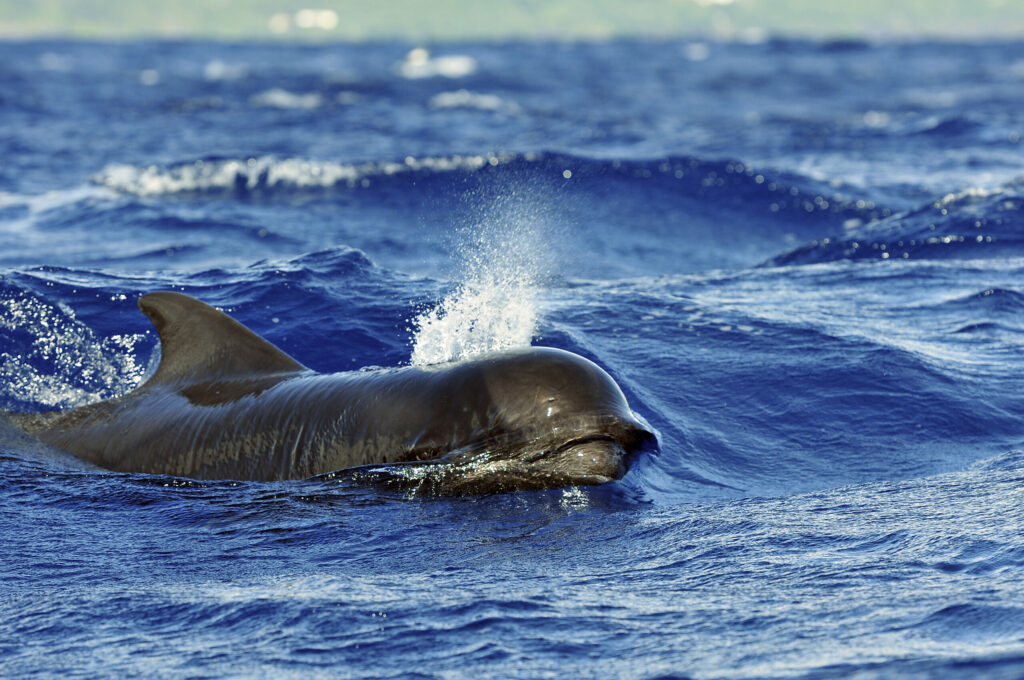
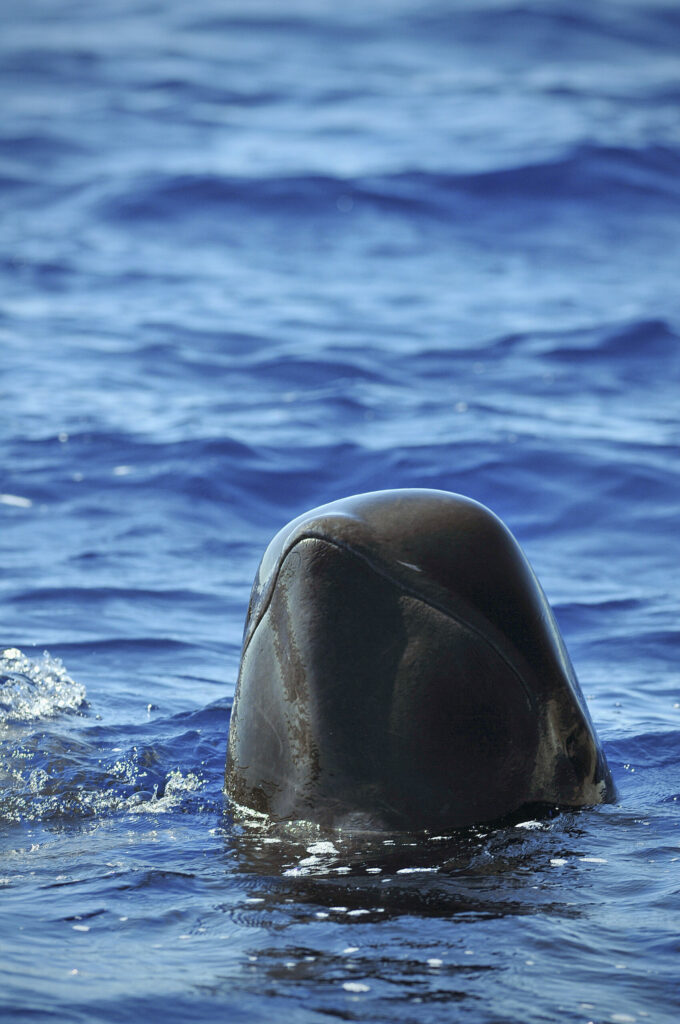
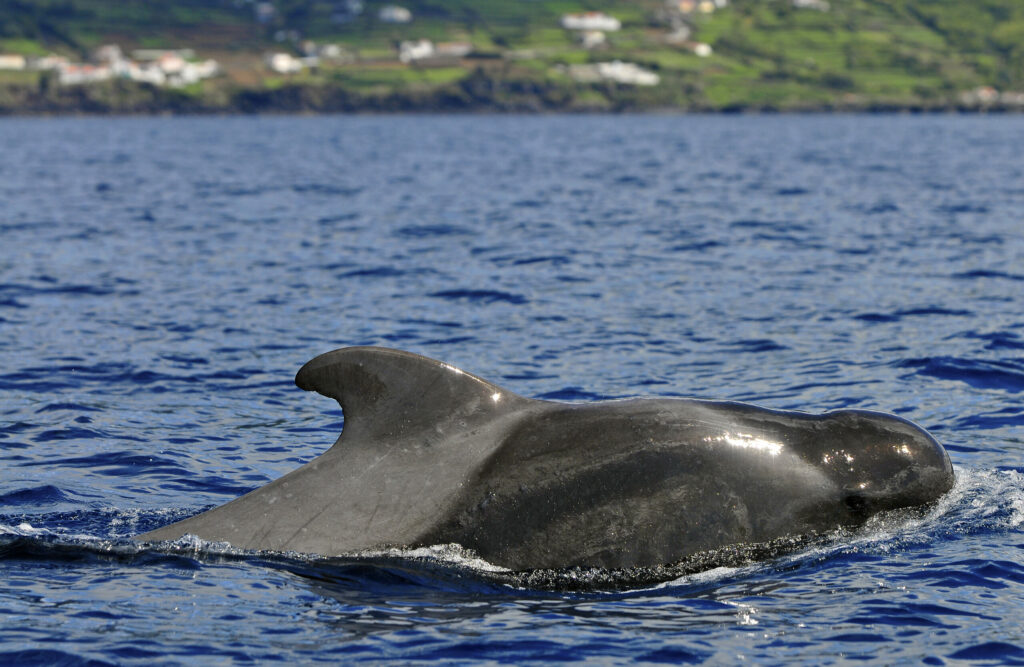
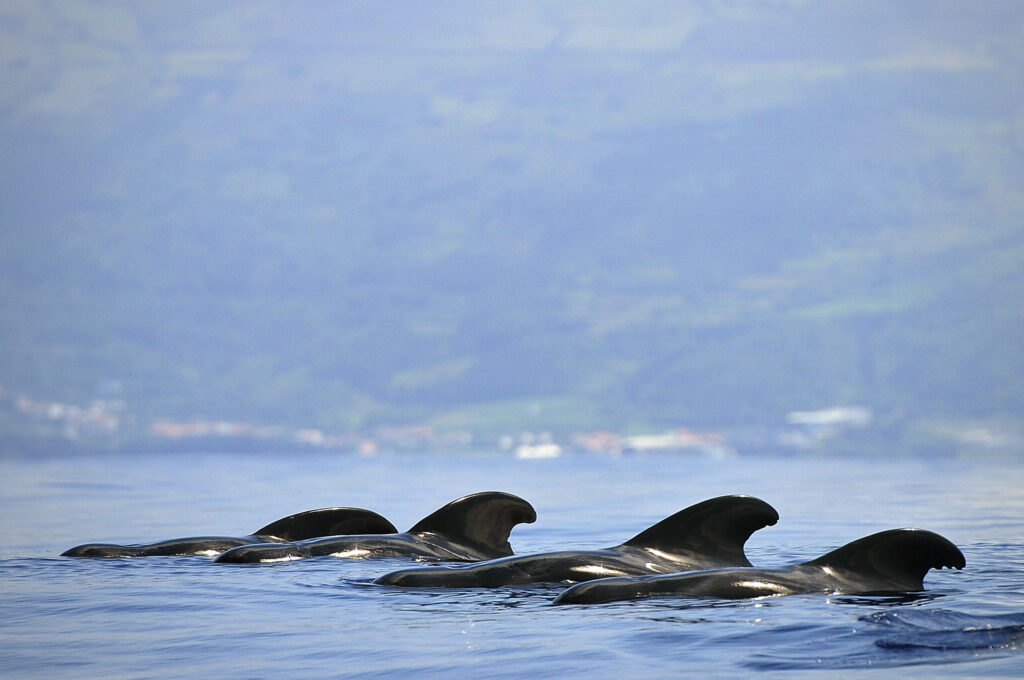
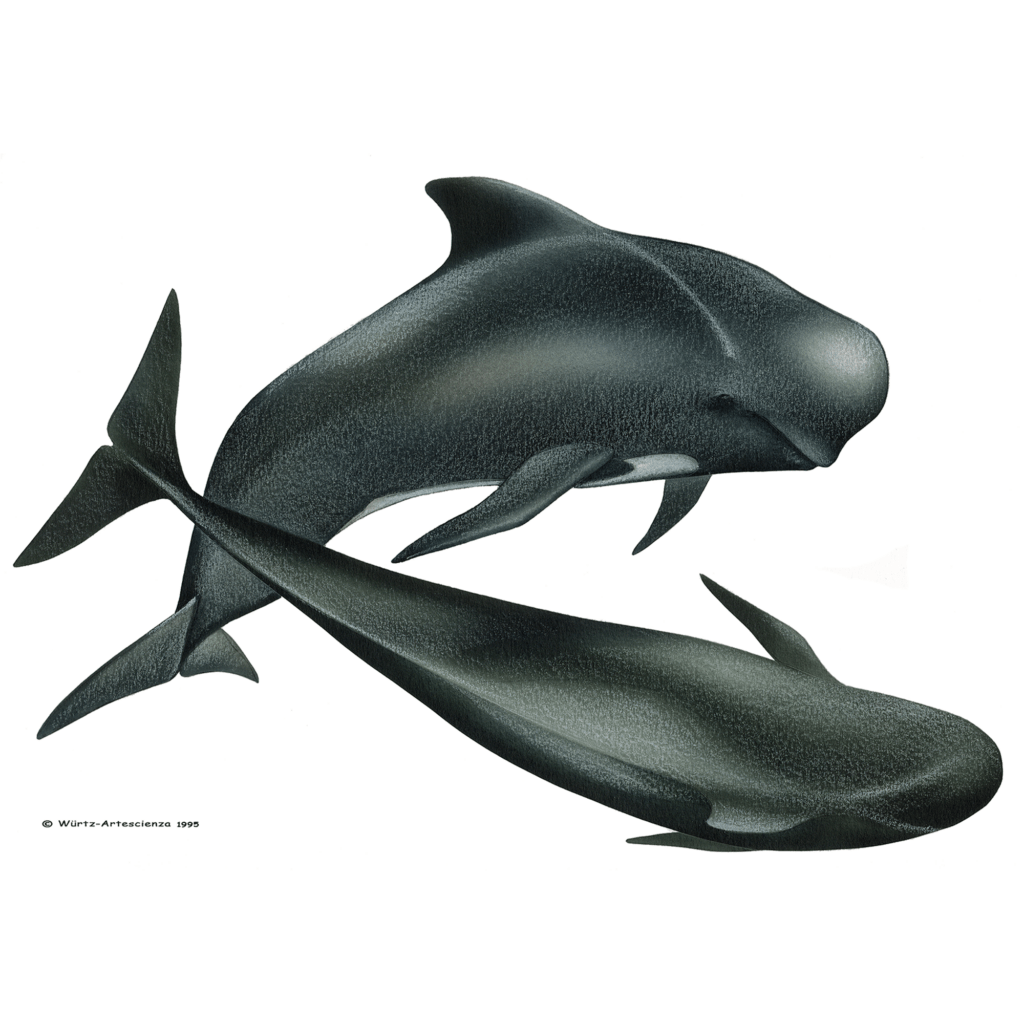
The short-finned pilot whale has a robust, elongated body that ranges from dark grey and brown to black. Characteristic features include a bulbous, globe-shaped melon that can overhang the mouth and a very short, almost invisible, beak. The dorsal fin is set relatively far forward (about one-third of the way back from the head) and has a very wide base with a swept-back (falcate) shape. The pectoral flippers are significantly shorter than those of the long-finned species, measuring about 1/7 to 1/8 of the total body length. Many individuals, especially adult males, show a grey or white "saddle" behind the dorsal fin and a grey anchor-shaped patch on the throat.
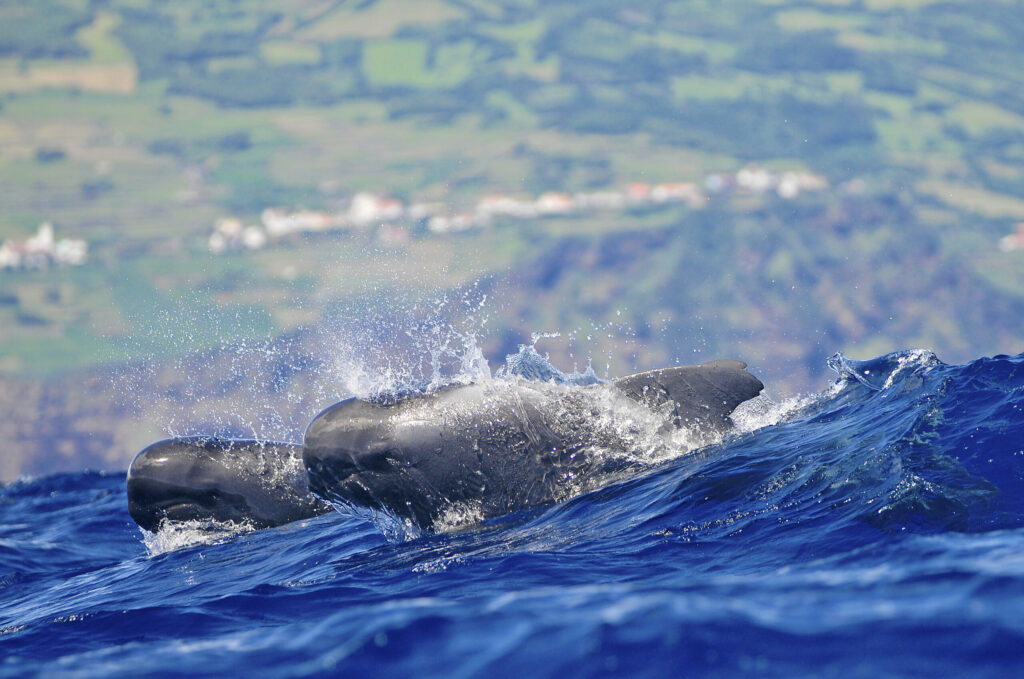
Highly social, they live in stable, maternally-based pods of 15 to 50 individuals, though hundreds may aggregate together. These strong social bonds, while vital for their survival, also explain their susceptibility to mass strandings. A unique behavior of this species is travelling in a "chorus line" formation, where the entire pod swims side-by-side across miles of open ocean.
The short-finned pilot whale has a robust, elongated body that ranges from dark grey and brown to black. Characteristic features include a bulbous, globe-shaped melon that can overhang the mouth and a very short, almost invisible, beak. The dorsal fin is set relatively far forward (about one-third of the way back from the head) and has a very wide base with a swept-back (falcate) shape. The pectoral flippers are significantly shorter than those of the long-finned species, measuring about 1/7 to 1/8 of the total body length. Many individuals, especially adult males, show a grey or white "saddle" behind the dorsal fin and a grey anchor-shaped patch on the throat.
Highly social, they live in stable, maternally-based pods of 15 to 50 individuals, though hundreds may aggregate together. These strong social bonds, while vital for their survival, also explain their susceptibility to mass strandings. A unique behavior of this species is travelling in a "chorus line" formation, where the entire pod swims side-by-side across miles of open ocean.
observation
Short-finned pilot whales are found in tropical and warm temperate waters worldwide. Unlike the long-finned pilot whale, they are absent from the Mediterranean Sea. In the Azores, they are more migratory than their colder-water cousins, typically moving south during the winter.
Identification Tips: Distinguishing them from the Long-finned pilot whale (Globicephala melas) is a challenge, but the short-finned species usually appears "brighter," with more pronounced grey patterns. The shorter pectoral flipper remains the only definitive way to tell them apart in the field. Generally, they tend to be more "shy" or cautious around boats compared to the long-finned pilot whale.
In the Azores, this is a seasonally frequent species, present on average in 20% of Espaço Talassa’s trips. While sightings can occur as early as April, they are most common from May to July, with observations continuing until November.
Identification Tips: Distinguishing them from the Long-finned pilot whale (Globicephala melas) is a challenge, but the short-finned species usually appears "brighter," with more pronounced grey patterns. The shorter pectoral flipper remains the only definitive way to tell them apart in the field. Generally, they tend to be more "shy" or cautious around boats compared to the long-finned pilot whale.
In the Azores, this is a seasonally frequent species, present on average in 20% of Espaço Talassa’s trips. While sightings can occur as early as April, they are most common from May to July, with observations continuing until November.
names
PT: Baleia-piloto-tropical (ou Baleia-piloto-de-aleta-curta)
AZORES: Peixe-boi
ENG: Short-finned pilot whale (or Pothead whale)
FR: Globicéphale tropical
DE: Kurzflossen-Grindwal
IT: Globicefalo di Gray
ESP: Calderón tropical
NL: Indische griend
AZORES: Peixe-boi
ENG: Short-finned pilot whale (or Pothead whale)
FR: Globicéphale tropical
DE: Kurzflossen-Grindwal
IT: Globicefalo di Gray
ESP: Calderón tropical
NL: Indische griend
Scientific name
Globicephala macrorhynchus
Discovery
Gray, 1846