

False killer whale
Pseudorca crassidens
biology
Newborn false killer whales are between 1.6 m and 1.9 m long. Adult males can reach lengths of 6 m and weigh up to 2 tonnes, while females are generally smaller. They possess 7 to 12 pairs of large, conical teeth in each jaw. Females are remarkably long-lived, reaching up to 63 years of age.
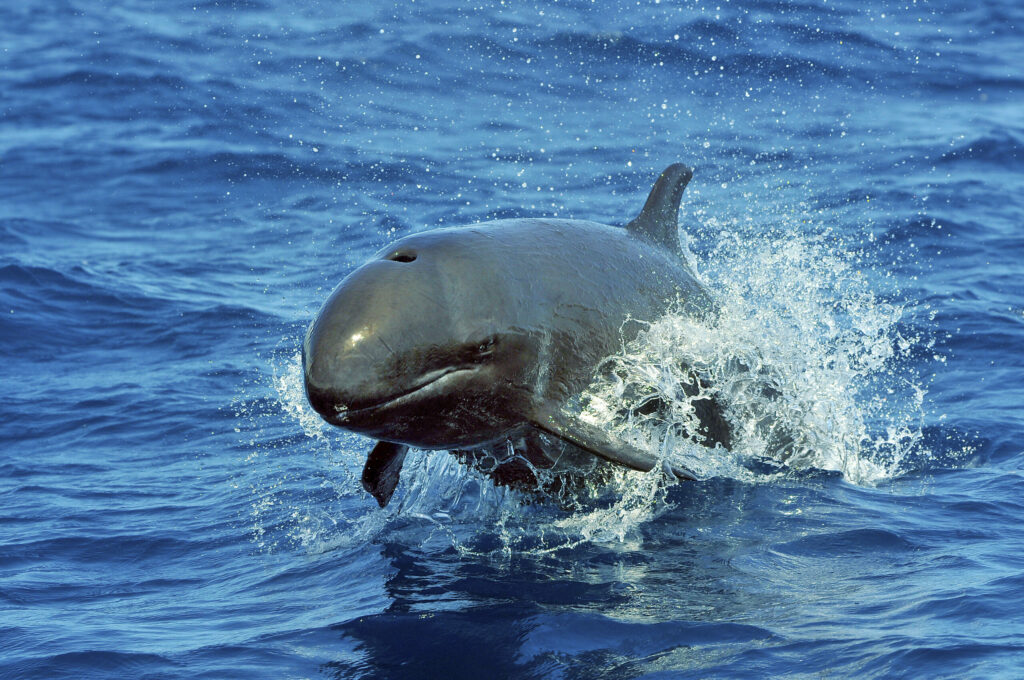
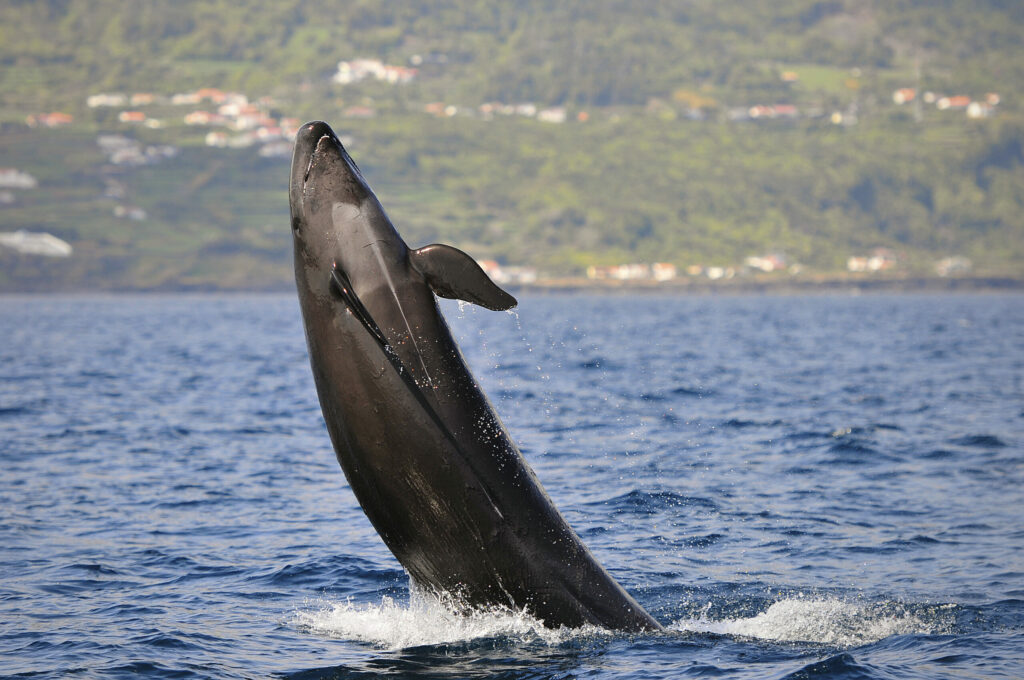
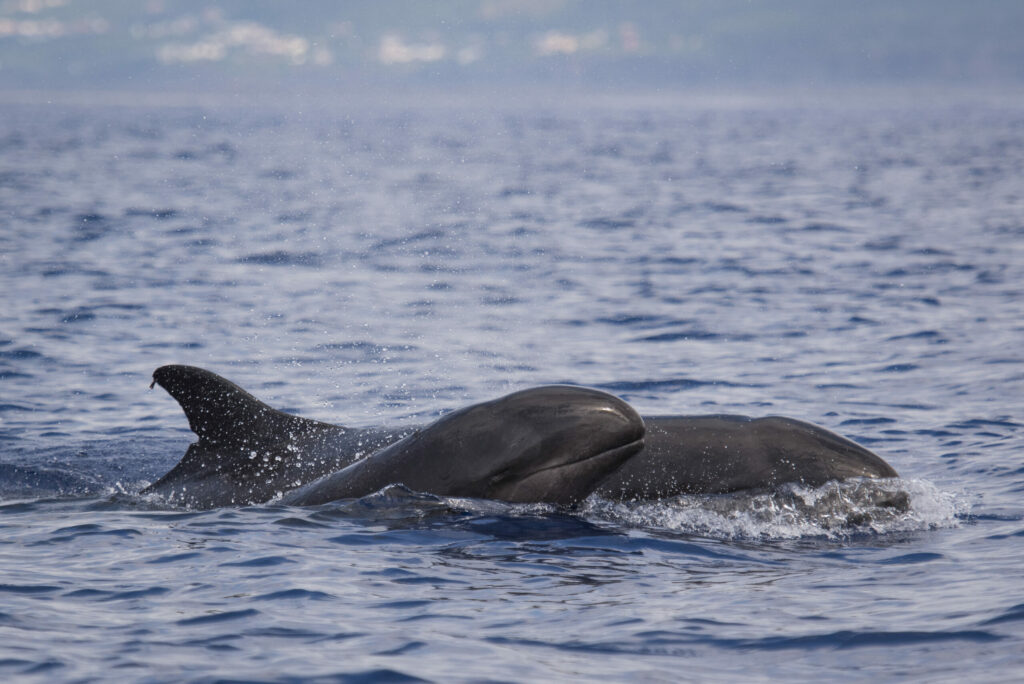
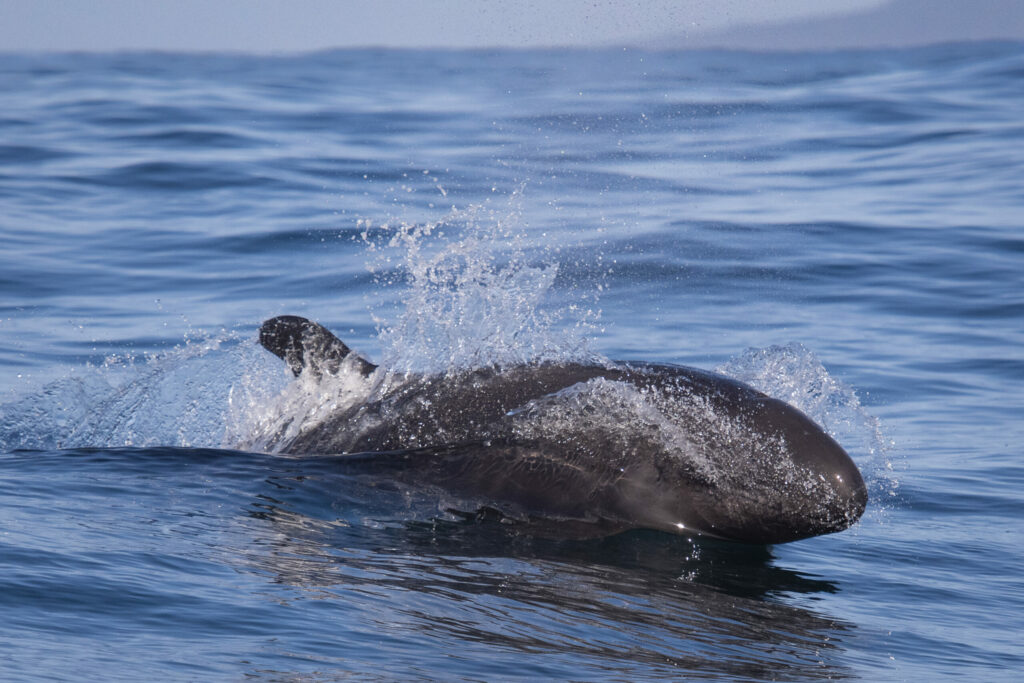
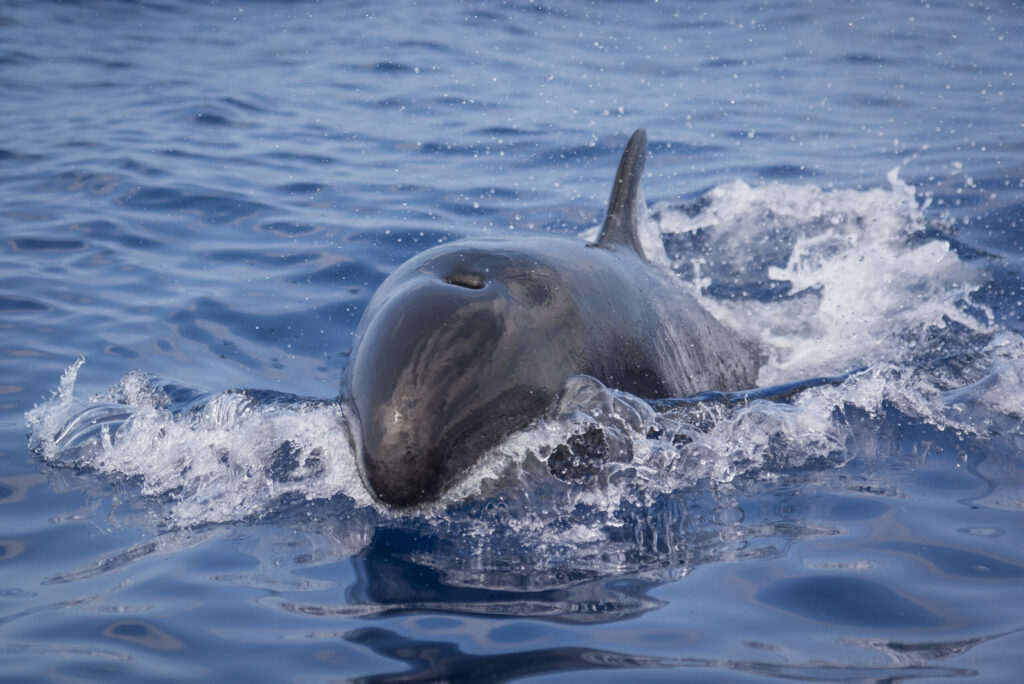
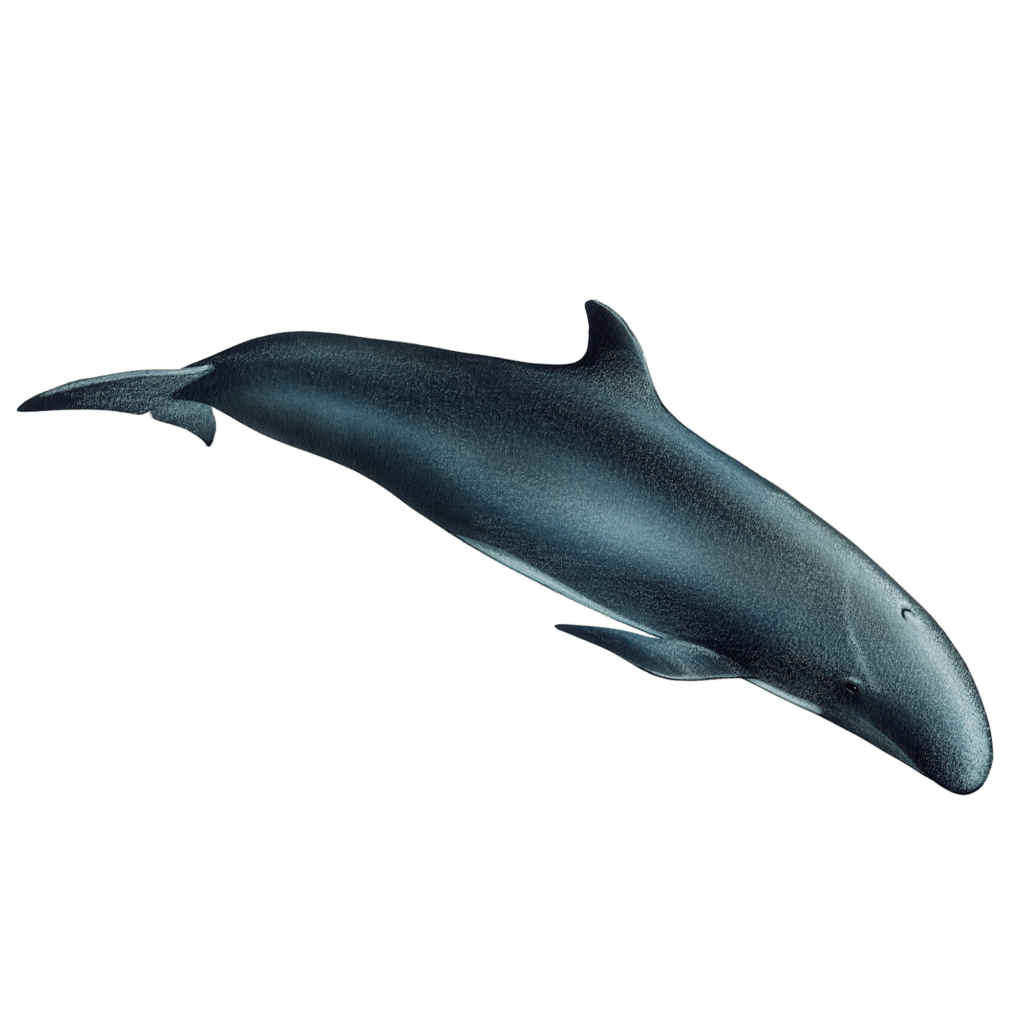
The false killer whale has a long, slender, and hydrodynamic body. The head is small and rounded with a poorly defined beak. Its coloration is almost entirely dark grey or black, except for a grey or whitish W-shaped (or anchor-shaped) patch on the chest. Their most unique and diagnostic feature is the S-shaped pectoral flippers with a pronounced "elbow" on the leading edge—this is the most reliable way to distinguish them from pilot whales at sea. The dorsal fin is tall, falcate, and positioned centrally on the back.
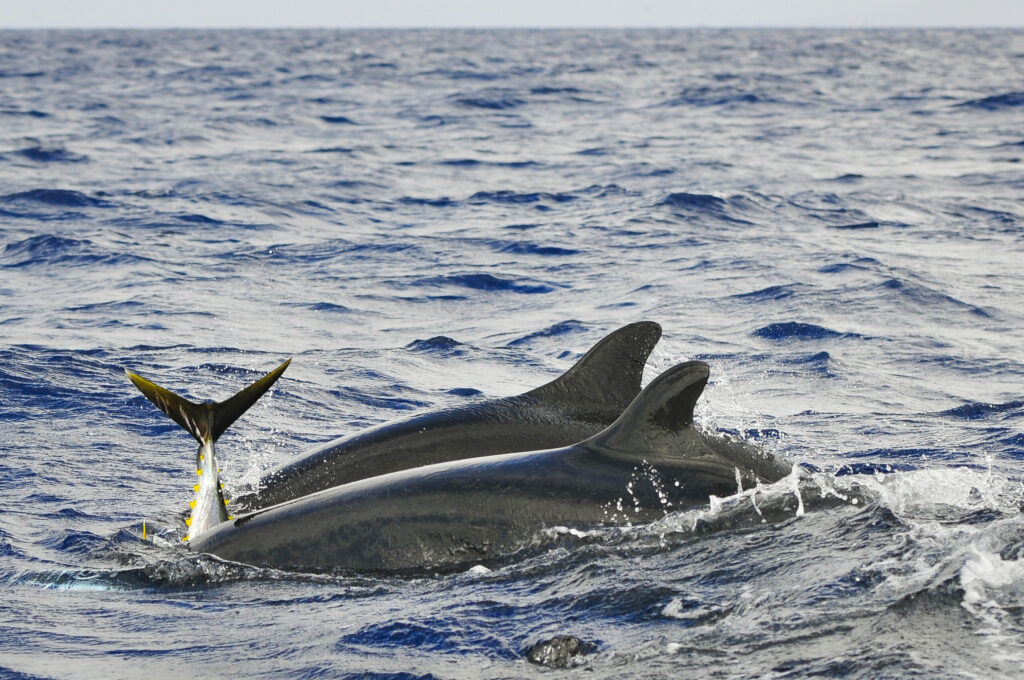
These versatile predators are known for their high intelligence and complex hunting strategies. In the Azores, they are frequently observed hunting tuna. While they occasionally feed on other dolphins and have even been seen attacking humpback whale calves, they are also highly altruistic within their pods, often sharing food mouth-to-mouth with other members, especially juveniles. They are extremely social, forming stable groups of 10 to 20 individuals that can merge into larger schools of hundreds.
The false killer whale has a long, slender, and hydrodynamic body. The head is small and rounded with a poorly defined beak. Its coloration is almost entirely dark grey or black, except for a grey or whitish W-shaped (or anchor-shaped) patch on the chest. Their most unique and diagnostic feature is the S-shaped pectoral flippers with a pronounced "elbow" on the leading edge—this is the most reliable way to distinguish them from pilot whales at sea. The dorsal fin is tall, falcate, and positioned centrally on the back.
These versatile predators are known for their high intelligence and complex hunting strategies. In the Azores, they are frequently observed hunting tuna. While they occasionally feed on other dolphins and have even been seen attacking humpback whale calves, they are also highly altruistic within their pods, often sharing food mouth-to-mouth with other members, especially juveniles. They are extremely social, forming stable groups of 10 to 20 individuals that can merge into larger schools of hundreds.
observation
False killer whales have an extensive oceanic range, inhabiting tropical and warm temperate waters deeper than 1,000 m. While they can be confused with other small "blackfish" species like the Pygmy killer whale or the Melon-headed whale in other regions, these are not typically recognized among the 28 species of the Azores.
Identification Challenges: At a distance, they are most often confused with Short-finned pilot whales (Globicephala macrorhynchus). However, pilot whales have a much more bulbous head and a wide-based dorsal fin positioned much further forward. The false killer whale’s slender profile and its tendency to be an active, fast swimmer—frequently bow-riding and leaping—help in identification.
In the south of Pico, sightings have been increasing, with an average of 9 to 10 encounters per season in recent years. They can be seen from March to October, with April, July, and August being the statistically best months for observation.
Identification Challenges: At a distance, they are most often confused with Short-finned pilot whales (Globicephala macrorhynchus). However, pilot whales have a much more bulbous head and a wide-based dorsal fin positioned much further forward. The false killer whale’s slender profile and its tendency to be an active, fast swimmer—frequently bow-riding and leaping—help in identification.
In the south of Pico, sightings have been increasing, with an average of 9 to 10 encounters per season in recent years. They can be seen from March to October, with April, July, and August being the statistically best months for observation.
names
PT: Falsa-orca (ou Pseudorca)
AZORES: Negro
ENG: False killer whale
FR: Fausse orque
DE: Kleiner Schwertwal
IT: Pseudorca
ESP: Falsa orca
NL: Zwarte zwaardwalvis
AZORES: Negro
ENG: False killer whale
FR: Fausse orque
DE: Kleiner Schwertwal
IT: Pseudorca
ESP: Falsa orca
NL: Zwarte zwaardwalvis
Scientific name
Pseudorca crassidens
Discovery
Owens, 1846